
Alita: Battle Angel Movie Review
Easy on the eyes, but light on the storytelling

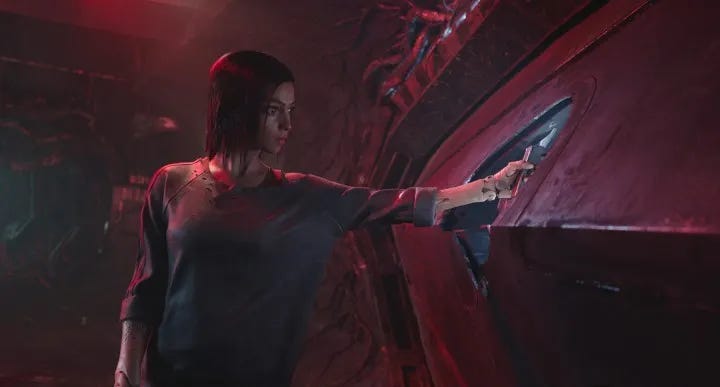
James Cameron may not have directed Alita: Battle Angel, but his fingerprint is easily seen in the Robert Rodriguez-directed spectacle, full of top-notch technology and visual effects. While the story may not feel entirely original or thought-provoking, one could also argue that’s another James Cameron trademark that made its way into the final product. This lessens the impact of the visuals, but at the end of the day, it’s hard not to be drawn into the world-building, much as viewers were by his Avatar films a decade ago.
Alita: Battle Angel follows the story of Alita (Rosa Salazar), a cyborg who is repaired by Dr. Ido (Christoph Waltz) and seeks to find herself and her place in the world, having no recollection of her former life. Along the way she crosses paths with her human love interest (Keann Johnson), the big bad guy Vector (Mahershala Ali), and plenty of other easily disposable side-characters, all furthering her journey to the truth.
If that plot summary sounds pretty run-of-the-mill to you, it’s because it is. The story takes few chances, although I’d argue that didn’t completely render it ineffective. Viewers are still on the edge of their seats pondering Alita’s identity, and thanks to a stellar performance from Salazar, viewers feel a wide range of emotions for Alita as she faces pain, love, hardship, and discoveries. Salazar really does sell the performance, the latest in a long line of motion capture performances that continue to impress me (look out, Thanos).
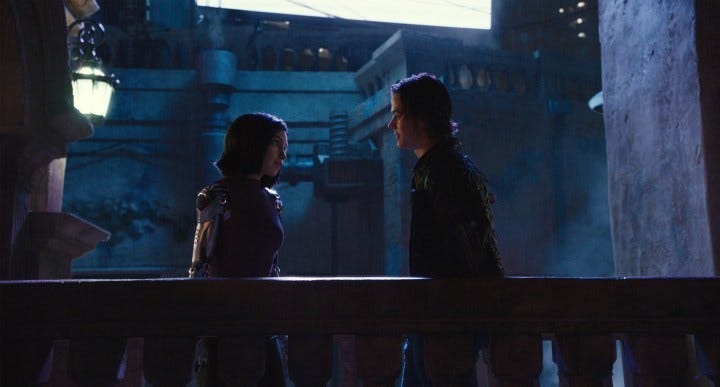
Waltz does what he can with a standard mentor/father-figure role, and Ali performs acceptably as the villain. That being said, the biggest character mistake was that of the love interest Hugo, played by Keann Johnson. He has quite a few scenes with Alita that are crucial to establishing an emotional connection, and he continuously fails to do so. I rarely cringe in theaters, but Johnson’s line delivery (or maybe the lines themselves) often made me cringe from the pure effort he was clearly exuding in an attempt to make his lines important.
That being said, the film’s technical aspects more than made up for any flaws in characters or writing. Between the detail and scale of the futuristic world and the realism of Alita’s character design, I was in constant amazement from one shot to another. I’d argue few, if any, films have done so much with this technology in the 2010s, and I’ve not experienced such a breathtaking immersion in film since Cameron’s own Avatar. One scene in particular that stands out visually involved Motorball, a complicated sport with roller-skating and killing in a giant arena (don’t ask me to explain the rules). This scene encompassed everything that is to be praised about the film’s CGI and motion capture. If anything, this is the scene that will be remembered in years to come.
Another impressive area of technical execution was the film’s score. Tom Holkenberg (also known as Junkie XL) has quite possibly created his grandest and most emotional film score to date, and gained much respect from me for his instrumentation and stylistic choices. While a few of his film scores have shown this potential, Alita gave him a chance to fully realize and develop his thematic ideas, and it contributed greatly to the storytelling and visuals.

You can probably tell I’ve been on the fence about whether to praise or complain about Alita: Battle Angel, and you’d be right. It has many flaws, but I can’t help but ultimately recommend it for the pure scale and visual feast that it presents. Go out and watch this in IMAX 3D and allow yourself to witness the action first-hand, even if the story it accompanies may not be as angelic as the visuals.