
'We Strangers' Interview: Director Anu Valia on Spirituality, Assimilation, and Subjective Editing
A conversation with Anu Valia on the power dynamics of domestic work, the ethics of clairvoyance, and her 10-year journey to becoming a 'caretaker' of cinema.

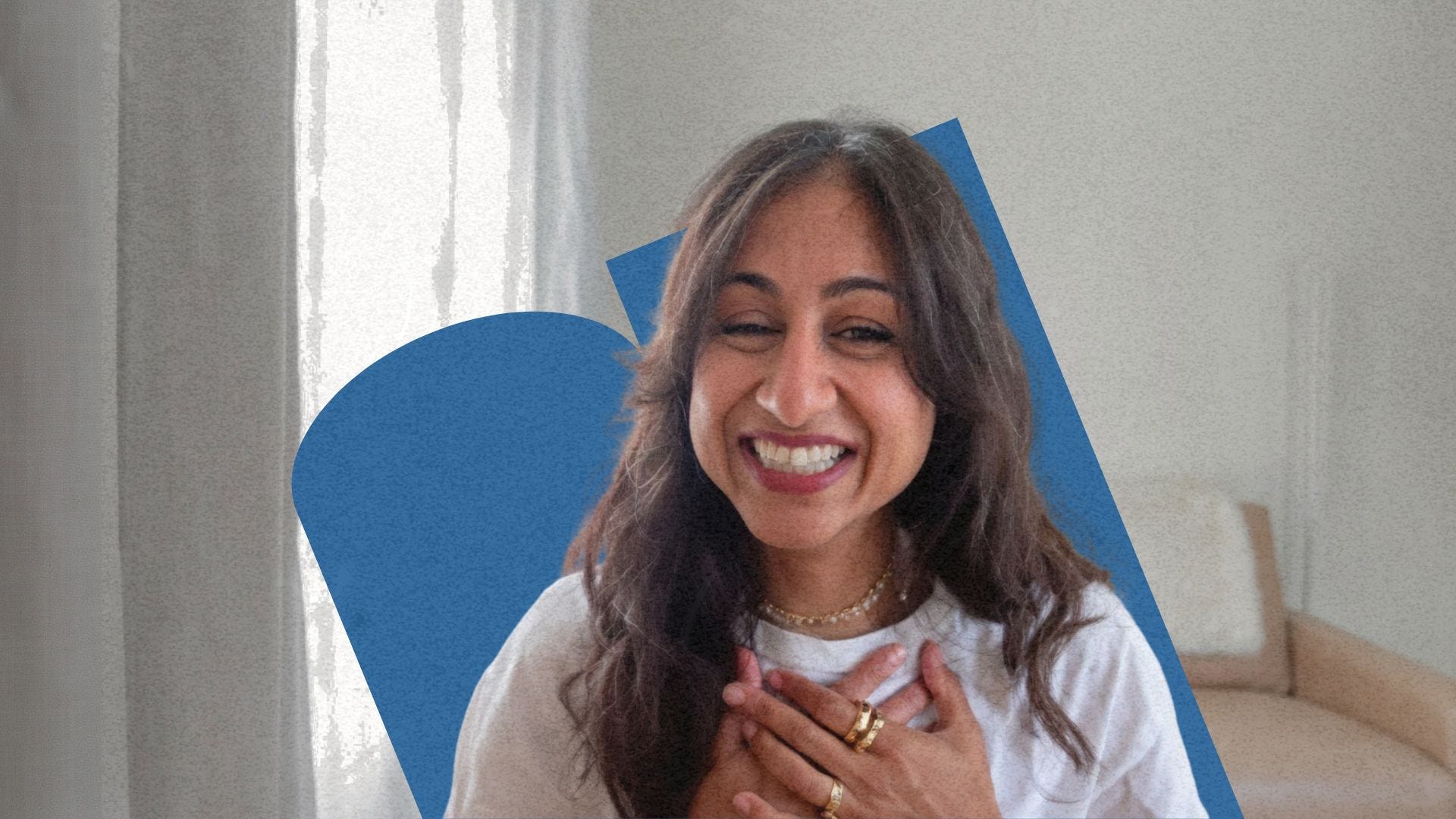
How does an outsider try to fit in? Anu Valia set out to ask this very question, a personal one to her, in her feature debut, We Strangers.
A SXSW 2024 Official Selection inspired by Valia’s own childhood in Gary, Indiana, We Strangers follows Rayelle (Kirby Howell-Baptiste), a young commercial cleaning woman who is offered a second job cleaning the homes of several rich, suburban families. To blend into her new surroundings, she inadvertently tells one white lie, which then flips the power dynamic in curious ways.
Valia and I recently sat down to discuss the film. During our conversation, which has been edited for length and clarity, we covered religion and spirituality in We Strangers, the power dynamics and assimilation at play in the narrative, and her directorial goal to be good “caretaker” of movies.
Well, first of all, thank you so much for giving me the chance to interview you. I absolutely loved We Strangers and so I’m glad we get to talk.
It’s really crazy because this is my first movie, and I’m just like … people saw it? Oh, boy, the naiveté! Thank you so much for seeing it. I appreciate that so much.
I’m sure it’s a little surreal! So, just a little background, my outlet is called A Cloudy Picture, and we focus a lot on religion and spirituality and how that intersects with film. In We Strangers you see a lot of those elements in play. I saw a recent study that said half of young adults regularly practice fortune-telling.
So, where past films like Elmer Gantry or Wise Blood might show characters exploiting others from within religious institutions, I thought it was interesting how We Strangers seems very attuned to clairvoyance as this increasingly popular form of modern spirituality. And as a result, we see that it’s an easy method of power and manipulation, too. So when you were writing and directing, were you consciously thinking about this cultural trend of turning to psychic practice for meaning, or did that just kind of emerge more organically throughout the process?
God, what a great question. I grew up religious, and I’m Sikh, so that’s my religion, my culture, my background. And one thing I’ve learned about religion and spirituality is that all people want to find meaning and purpose in life, right? And I understand, even nihilists have a way of thinking, right?
One thing I wanted to explore was that Ray sort of feels like this outsider who’s not really welcome. She understands subtextually she’s very much on the other side of these relationships. I don’t even think she’s conscious of this. I don’t think people always work super consciously to what they’re thinking, but she’s using her ability to speak truthfully, because she never lies, as she says, to speak truthfully to people’s kind of black holes inside and people’s wanting... people’s disconnect from their meaningfulness, the meaning of their lives. And she’s kind of reflecting that back to them.
And I think these people, who are a little bit blind, love that about her and think she has some special psychic ability. And who am I to say if she does or doesn’t? I think she’s deeply intuitive, and I also think a lot of psychics who are real and true and have a connection... have deep, deep intuition. And who am I? I’m not a scientist, so I don’t know what that all is. I won’t conjecture.
But I’m sure trends in the culture affect me, like I’m sure that’s in there. You know what I mean? And also, I’ve watched some of these medium shows, and who can’t help but watch these shows and go, “Is that person lying or is that person...?” And I have my own morality around it or whatever. So, to answer your question, I’m sure it was conscious in a way. It wasn’t at the forefront, because at the forefront of my mind was like, “How is this person using her ability to assimilate, to code-switch, to tell people what they want to hear, to gain access in a place that does not want to give her access?” That was a bit more at the forefront of my mind. But I love that interpretation. I think that’s really interesting.
Thank you for that. And I absolutely love, like you said, that assimilation piece of it and sort of the power dynamics, because she’s a cleaner. So she’s literally cleaning up people’s messes, but whenever she kind of tunes into this aspect, it seems like she’s almost being tasked with cleaning up their emotional and spiritual messes, if you will. Talk to me a little bit about the intention behind that. What does that say about how the world perceives her?
Well, I think that, first of all, I do like exploring dynamics. I think any artist... you see certain things in the world and then you sort of want to reflect them back. I don’t think there’s anything inherently wrong with having an employer-employee relationship. I don’t think that’s a bad relationship.
What I find interesting is this sort of one-person-has-a-lot-of-power push-and-pull, right? The employer can be like, “You’re just like family to me,” but actually, “I’m busy right now, I can’t talk to you.” It’s not a two-way street. I find that to be very fascinating. And how does a person who is the employee, who absolutely has their own life and dreams and life to offer, what if that person says, “Hey, I deserve to be here, you know? I deserve to be the main character of my own movie.” And so... man, your question was?
How do you think her world perceives her, both as her literal occupation but then kind of the emotional dynamics, too, of her taking on these additional roles and offering this spiritual advice, if you will?
I think she’s in two worlds. I think she has the world she’s in with her family and her best friend, where she’s very, very comfortable and she can move a lot more seamlessly. And then there’s a world that she enters when she starts working for these families. And I don’t even know if she is perceived. I feel like the decision, which is not that conscious, to just tell this lie that spins out of control, I think it comes from feeling like you are completely just a fly on the wall and you don’t matter at all.
You talked a little bit earlier about, “Who are you to say what’s real, what isn’t?” And I loved how the structure and the editing were really providing this almost dreamlike tone. It was very ethereal. You’ve got the cutaways to that volcanic mountain, you’ve got the close-ups of cleaning, even a scene of her dancing that just feels very dreamlike in tone. So, both from a directing standpoint and then in the editing room afterwards, how did you approach creating that very unique atmosphere?
Yeah. So, James Codoyannis edited it, and we’ve been editing shorts together since we were like 19, since we were in college. And so we have this beautiful... I mean, he is a cinema savant. It’s like he’s seen everything. And we made this beautiful language, and we were really conscious and desiring to make a movie that was in the third-person subjective.
So the way I sort of think of that is, this is subjective. It is just Ray’s experience. I want you to feel for Ray and really look at the world through Ray’s eyes, but it’s not this handheld film that’s just following her and we’re “inside” of her. We’re still watching her. We’re still watching her with a little remove and kind of being like omniscient watchers as well.
And so we were trying to create this tone that is both with her and with how she kind of moves through the world. This whole experience is sort of going to be a memory. It is dreamlike, and it’s supposed to feel like you kind of enter this fog. And all of these are facts. The camera’s very placed, right? Like everything that’s happening is true and real, but there’s still something a bit hazy about it.
And so we watched a ton of movies and were inspired by—aka stole—a bunch of ideas from many other directors who are better than me that can kind of create this very specific tone. We really wanted to make a movie that... it’s hard to, for better or for worse, find a comp for. I think there are comps when you’re trying to market a movie, but it’s its own thing. So that’s what I believe cinema can do. It can create its own sort of language, and that hits for some people.
I love that. The best artists steal, right? So, I think I’ve got time for one more question with you. The film felt very personal and lived-in. When I was reading the materials, it was great to find out that this was kind of inspired by your childhood in Indiana. So, how did those childhood memories influence both the writing, but also your direction of the actors?
Yeah, I mean, the film takes place and was shot in and around my hometown. I think most filmmakers, when you’re making your first movie, you kind of work with what you know, and you kind of have to also exorcise your childhood. You have the longest amount of time to make your first, hopefully. So, yeah, the feeling of the movie, I think, is this idea of what does assimilation do to a person, what it feels like to be a chameleon, both good and bad. I connect deeply, deeply with that. And obviously, it’s through the cipher of a woman who cleans other people’s houses, who’s this fly on the wall. That is taken and inspired by a lot of people I know. It’s a real mix.
And I think the truth is, the not-sexy answer is, over the ten years it took to make the film, so many things... I started writing the movie in a different decade than ending the film and now talking about the film. So, the film really kind of snowballed and took on a lot of different things. Even from the time I shot it to the time I edited it, I was in different places. So that kind of all incepts into the movie and it becomes its sort of—that’s what we would talk about on set—it kind of becomes its own thing. And Guillermo del Toro talks about this, like everybody else kind of puts themselves in the movie, and the movie starts to become this thing that’s almost removed and you’re just the caretaker of the film. It’s not even... you know what I mean? So... yeah.
Well, you were an excellent caretaker. It was a wonderful film, and I am so excited to watch whatever it is that you may have coming next. So, thank you so much again for your time.
Thank you, Christian. That’s beautiful. I would love to be a good caretaker for film.