
What Was I Made For? Barbie, Frankenstein, and Rebelling against the Creator
Barbie (2023) and Frankenstein (2025) are very different films. They share one haunting question.


The following was first published on Film Fisher.
In 2023’s Barbie, the titular character and her inventor, Ruth Handler, share a special moment together in an ethereal, light-filled kitchen. Handler extends a cup of tea across a table toward Barbie (Margot Robbie), and the framing deliberately invokes Michelangelo’s The Creation of Adam. “That’s the Sistine Chapel shot,” says director Greta Gerwig. “That’s her hand reaching to Margot’s [like] God to Adam, giving her life.”
This moment’s significance may be easy to miss, but Barbie plays with the language of creation, fall, and identity for its entire runtime. And it is not alone. Guillermo del Toro’s Frankenstein, which arrived two years later and boasts nine Academy Award nominations, including a Best Picture nod, is doing something remarkably similar under very different conditions: exploring what happens when a created being looks at the world it was placed in, looks at the one who placed it there, and asks the question that neither creator wants to answer.
What was I made for?
The two films couldn’t be more tonally opposite, yet, at their core, they are telling the same story. So why does Hollywood keeps returning to this story? And what does this reveal about how the world understands God?
The Creatures
Barbieland is, without much subtlety, the Garden of Eden. Production designer Sarah Greenwood constructs it as a hyperreal diorama, using highly saturated pinks and impossible geometry to depict a seemingly perfect paradise in which the Barbies do not age or suffer. Every day begins and ends the same way, down to the same catchy song that plays over their morning routines. It is, in the language of Genesis, “good.” Or at least it looks that way.
That all changes when Stereotypical Barbie thinks about death. From there, the imperfections multiply hilariously (including flat feet and cellulite, gasp!) until she is no longer fit for the paradise of Barbieland. Much like Adam and Eve’s sin introduced imperfection into a perfect world, Barbie’s “imperfection” means she cannot stay. She must leave the garden.
But here is where the film diverges from Genesis in a telling way. When she finally reaches the real world – a world of confusion, heartbreak, malice, and greed – the film treats it as more real, more worth living in than the paradise she left behind. Gerwig documents her arrival in Los Angeles with a kind of double vision, including a stark contrast in cinematography and production design. We see how strange this world looks to Barbie, but also how much stranger, in retrospect, Barbieland now appears. Barbieland isn’t treated as a perfect, heavenly realm, but as a naive and silly fantasy.
It’s also worth noting that sin doesn’t only enter Barbieland through Barbie. Ken (Ryan Gosling) travels to the real world and comes back corrupted by pride, implementing a patriarchal ideology into Barbieland, tainting the garden through his own encounter with the outside world. Ken unwittingly acts as the serpent here, tempting the innocent residents of Barbieland with promises of knowledge and power.
As the film goes on and Barbie learns more about herself, humanity, and the world, Barbie discovers that she cannot want only the good parts. Imperfections are not flaws that hide her meaning; they are the meaning.
Meanwhile, Frankenstein is the film Guillermo del Toro has been building toward his entire career. He has always been, at his core, a filmmaker of creatures who are more human than the humans (see The Shape of Water or Pinocchio). And like much of his filmography, Frankenstein is less interested in viewing its monster with horror than with tenderness.
The prosthetic design by Mike Hill reflects this shift in focus. “I didn’t want him to look like a monster,” Hill states. “I wanted him to have these geometric shapes, almost mechanically stitched together, so when you saw him, you’d think, ‘Oh, no, this is not an accident. Somebody put this man together.’” The Creature is, visually, the most careful thing Victor has ever made. And he is also, immediately and obviously, a person, not a thing.
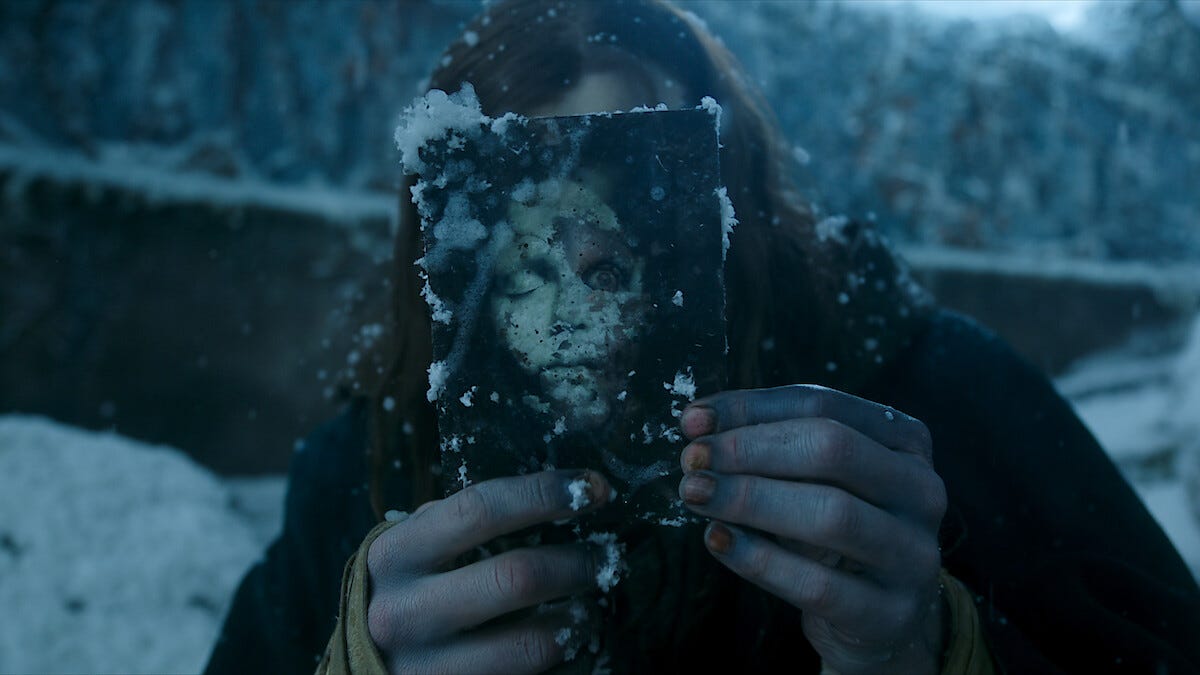
Frankenstein’s Creature (Jacob Elordi) lives the early parts of his conscious life in a dungeon beneath Victor’s tower, damp and cold and lit only by circular apertures in the ceiling through which thin shafts of light descend from above. Cinematographer Dan Laustsen shoots this space in deep focus to further emphasize the Creature’s isolation registers, showcasing the cruelty and loneliness of the hell he lives in, reaching periodically toward those circles of light, the heaven where his creator lives, absent from the Creature’s life.
Victor destroys his tower in an attempt to kill the Creature, a scene that feels equal parts Sodom and Gomorrah and the Great Flood. Fiery flames and explosions rock the tower while rising waters nearly drown the Creature in the dungeon. Narrowly escaping, the Creature finds comfort and companionship in a blind man in a forest cottage. Del Toro treats these scenes as a deliberate visual rebuke to everything that came before. Where Victor’s tower is shot in a wide, cold, and dark manner, the blind man’s cottage is warm, small, and intimate, filled with the vibrant greens of the surrounding forest. The Creature reads everything the blind man has, finding parallels to his own creation in the creation of the first humans.
“I read my first story- and it was the first story. I read about a man named Adam and a woman named Eve- about their time in the first garden, and I was in that garden. And then I read about the rise of rival cities and the collapse of a tower and the wrath of a God.” — The Creature, Frankenstein
When the Creature finally confronts Victor, having learned the origins of his creation and the identity of his creator, it once again resembles the Bible’s creation story: “You made Someone. Why? I do not know. You gave me no reason nor offered meaning. I have but this sole petition, creator... even beasts have a mate. Why should I be alone?” But while the God of Genesis realized this need before man did (Genesis 2:18: “It is not good for man to be alone”), Victor refuses to recognize the needs or even the purpose of his creation.
And that brings us to the flawed creators and stewards present in Barbie and Frankenstein.
The Creators
A crucial connection and distinction between these two films is the nature of their creators’ failures.
Victor Frankenstein (Oscar Isaac) fails from the beginning, a characterization Del Toro is explicit and, ultimately, too insistent about. Victor is cold, self-serving, and frankly manic in his pursuit of mastery over death, a hunger the film traces back to his father’s cold discipline and his own ambition.
Isaac’s performance ventures a bit too far into caricature compared to the nuanced character originally created by Mary Shelley. Victor’s tragic losses in life and driven persistence are the qualities of a flawed man that the audience should feel at least somewhat sympathetic toward, but in the film Victor is simply a cruel and uncaring creator that models his own father’s abusive traits. The result is a structural problem: the film’s first half following Victor functions not as a parallel perspective on the same tragedy but as a cruel prologue to the only POV that del Toro cares about: the Creature’s. It’s a unique take on the story, but the film pays a price for it: we never love Victor enough to understand him as creator or grieve his lack of repentance.
In Barbie, Ruth Handler is presented with warmth and a kind of distant wisdom. Barbie approaches her with genuine awe, uncertain and reverent in her presence. The aforementioned “Sistine Chapel shot” is genuinely reverent; the humor and ironic self-awareness that much of the comedic film relies upon is absent here.
But Barbie’s creator exists on two levels in this film, and the second level is Mattel, the corporate institution built in the creator’s name. The executives (led by a goofy and overdramatic Will Ferrell) spend most of the film chasing Barbie down, desperate to return her to Barbieland, restore her marketability, and eliminate the anomaly she has become. They are less concerned with Barbie’s flourishing than with Barbie’s compliance.

Victor, Ruth, and Mattel’s boardroom are all different flavors of a failed creator. Victor fails through what he is: cold, reckless, a man who “had never considered what would come after creation” (his words). He is a creator who never cared about the created, and del Toro never lets us forget this.
Mattel, by contrast, fails through what it has become. Ruth never foresaw the extent of her creation’s impact, and after her inevitable passing, Mattel monetized her original intention until it was functionally unrecognizable from the outside. It is an organization that has lost the spirit of its founding in favor of profit.
Ultimately, both Victor and Mattel respond in the same way when their creation doesn’t turn out the way they hoped: “We must put this [Creature] back in the box.”
The Savior
This reading of the films creates an unsubtle parallel to the church: a corporation that hunts down non-conformists rather than loving them, that treats questions as threats and imperfection as liability, that defines acceptable behavior entirely in terms of what is useful to the institution. These qualities are recognizable to anyone who has encountered organized religion in its more flawed state. Del Toro makes the same observation through Victor himself. Victor built his entire life around gaining mastery over life and death, and the result is a being made with extraordinary craft but no love, placed in a dungeon and punished for not developing quickly enough.
When the church has functioned this way – when it has been retributive or self-serving rather than a faithful, loving steward – we should not be surprised that the world writes stories about righteous rebellion. Christians have shown them a flawed image of God. They believed it.
So countless viewers ask alongside Barbie and the Creature...“What was I made for?”
These films among others (Poor Things, Ex Machina, The Truman Show, Wish) suggest that secular culture’s answer to this question has been shaped, more than Christians would like to admit, by religious institutions that looked less like a father running to his child than like a boardroom managing their assets. More and more films are pointing out the perceived flaws of the Creator and asserting that human autonomy and rebellion are the rightful response as a result.
Both films do end with their created beings returning to their creators, but only for a final confrontation. Barbie sees another vision of Ruth Handler, and when given a choice between Barbieland and the real world, chooses mortality. The Creature finds Victor on his deathbed and chooses forgiveness, calling Victor his father for the first and only time in the film and saying “Rest now. We can both be human now.” After that, the creation is left to fend for itself. Ruth’s apparition vanishes, Victor dies, and Barbie and the Creature must, as Frankenstein’s ending text muses, “brokenly live on.”
If the world’s image of God and the church looks like a mad scientist that abandons us and a corporate boardroom that controls us, then perhaps Christians have been a poor witness. What neither Gerwig nor del Toro can offer (because neither Mattel nor Victor can offer it) is a perfect creator who, like in the parable of the prodigal son, is watching the road and lovingly runs to embrace their creation. The answer is a church that preaches and models this image of a Creator, the One who not only made us, but ran to find us after we wandered off.
“But while he was still a long way off, his father saw him and was filled with compassion for him; he ran to his son, threw his arms around him and kissed him.” — Luke 15:20
This is a great piece. I recently wrote about GDT’s Frankenstein in the context of other creature-vs.-creator stories and completely missed the Barbie connection. Thanks.