
Breaking Down the Arts & Faith Top 25 Films Directed by Women
A juror’s look at the triumphs and omissions of the new Top 25 list.

Today, the Arts & Faith community announced the Top 25 Films Directed by Women. Each year, a group of jurors nominates and votes on a top 25 list identifying the best spiritually significant films within a certain theme. This was the sixth list of which I’ve been a juror, but the nine month process the community and I spent in crafting this one has been particularly special.
Here are my extended thoughts on the process and results.
On the Topic of Spiritual Significance
While not a part of this year’s official list name, Arts & Faith frequently clarifies their lists as the Top 25 Spiritually Significant films about a topic. That modifier isn’t necessary (it’s implied considering the name and purpose of the group), but it does help to keep in mind our north star: identifying spiritually significant films.
This means that film ratings and consensus “best films of all time” play less of a role in Arts & Faith than in typical film circles. Likewise, spiritual significance is an important factor in decision-making for the Arts & Faith lists that obviously isn’t represented in a film’s Letterboxd rating or the AFI Top 100.
The Godfather (1972) is widely considered one of the best films of all time, but didn’t make an Arts & Faith list until 2024. Citizen Kane (1941) hasn’t been on an Arts & Faith list in 11 years. On the other hand, Robert Duvall’s largely forgotten The Apostle (1997) has appeared on eight Arts & Faith lists, including the #33 spot in last year’s top 100 list.
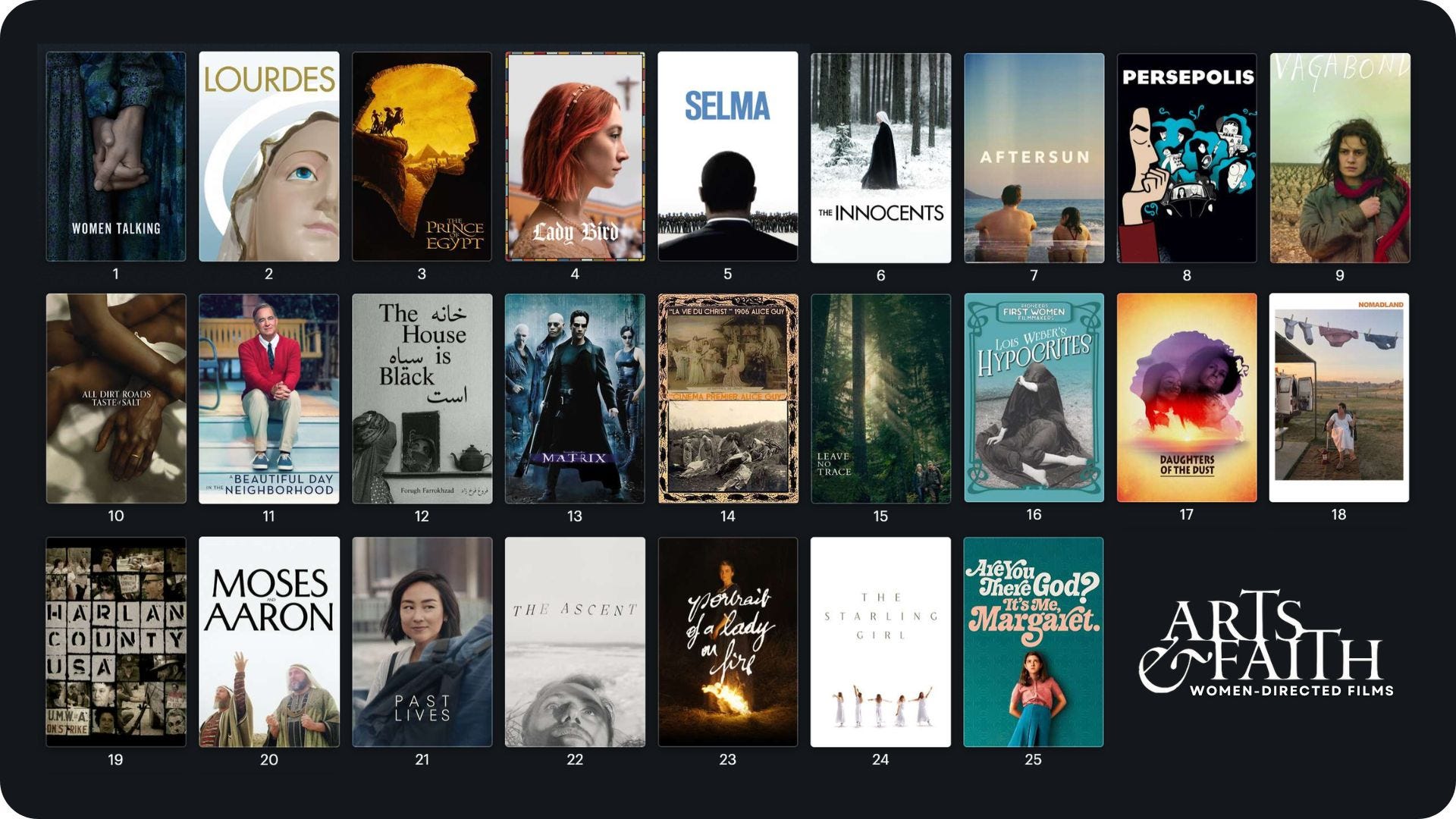
When focusing on women-directed films specifically, Women Talking (2022) may not be considered among the greatest films ever made, but it’s hard to dispute the film’s spiritual significance. Meanwhile City of God (2002), the highest rated film directed by a woman on Letterboxd, wasn’t even among the initial 105 Arts & Faith nominees.
What even is “spiritually significant?” Understandably, everyone has a bit of a different answer. Spiritual significance doesn’t have to mean an overt religious setting or Christian message. After all, the belief of my blog is that one can find spiritual significance in any film, and I’d imagine most Arts & Faith jurors would feel the same.
But we all have internal processes for what constitutes spirituality, and that informs our selections. I may not have agreed with all nominees—options such as American Psycho (2000) and A League of Their Own (1992) raised a few eyebrows during the process—but jurors were able to make compelling arguments for why those films had something to say spiritually, even if they didn’t make the final list.
On the Topic of Women-Directed
One of the great difficulties in being a juror for Arts & Faith lies in defining the list topic alongside defining the aforementioned “spiritually significant” criteria. What is a “crime and punishment” film? What is a film about “waking up?” Past Arts & Faith lists covered those topics and caused a range of debates (one juror argued WALL-E involved maritime law and was therefore eligible for the crime and punishment list).
At face value this year’s list topic seemed more straightforward than past, less easily defined themes. However, when it came to nominations and voting, the community realized things weren’t so simple. Voters fell somewhere on a spectrum of three schools of thought (my names for these schools are completely made up):
The Absolutist: All that matters is that a film was directed by a woman and is spiritually significant (though, as mentioned above, definitions of spiritual significance vary greatly). Film history and feminist impact are not taken into consideration.
The Feminist: Films must be more than just directed by a woman, but should somehow be demonstrative of the experience of being a woman. Perhaps that means featuring a female protagonist, dealing with themes more specific to womanhood, or being affected by a woman’s direction.
The Canonist: Certain films and/or directors are essential to the history of film (particularly women in film) and should be included in the list, even if their spiritual significance is lesser.
I fell on the absolutist side of the voting body, but I see merit in all lines of thinking. This varied attitude toward voting also explains some of the voting results. While I won’t share specific voting numbers, Women Talking easily earned the number 1 spot on the list. The film is about women’s experiences with faith and religion, and is written and directed by Academy Award winner Sarah Polley, thus appealing to absolutists, feminists, and canonists alike.
Similarly, The Prince of Egypt (1998) landed at number 3 on the list, a film that gives added weight to female characters in the Exodus story such as Tzipporah and Miriam, and also marks the first animated feature film to be directed by a woman. Most of the selections that made the group’s top 25 are films that managed to appease all three schools of thought.
It should be noted the list follows a one-film-per-director limit; any filmmaker with multiple nominations was narrowed down to a single representative title during an early voting round. Greta Gerwig’s Lady Bird (2017) was selected over Barbie (2023), Ava DuVernay’s Selma (2014) was chosen instead of Origin (2023), and so on. Several directors had multiple films nominated, but missed out on the final list entirely. Sofia Coppola, Penny Marshall, Kelly Reichardt, and Jane Campion were among those unfortunate omissions.
The Arts & Faith community has floated the idea of a list of films directed by women for several years, due in no small part to the fact that our lists (and, frankly, lists from most film communities) have been men-centric. Kenneth Morefield wrote an excellent blog, Crawling Towards Diversity, in response to the 2020 Arts & Faith Top 100 list, which contained only 6 films directed by women. After our 2025 Top 100 list only raised that number to 9 films, the group decided it was time to recognize more spiritually significant works directed by women.
Interestingly, only 11 films on this list have never appeared on a previous Arts & Faith list. Now maybe I’m a glass half-empty guy; after all, one could argue that nearly half (44%) of the list being new selections is a success. Some truly great films appear here for the first time, from La Vie du Christ (1906) to Aftersun (2022).
But I wonder if this process will impact future Arts & Faith lists, as was one of the goals. If a dedicated focus on women-directed films only surfaced 11 new titles, can we expect the 2030 Top 100 to change drastically? Perhaps the results simply confirm that the group’s previous lists had already recognized the most significant films in this category. Only time will tell.
Let’s Look Further at the Data
It should come as no surprise that the list leans heavily modern. The 2020s are the most represented decade (seven films), with four of those films released in 2023. By contrast, only 10 films were released before 2000. This trend mirrors the industry at large, since the percentage of women-directed films has increased significantly in recent years (though remains embarrassingly low).
In 2023, 16% of the top 250 grossing films were directed by women. Compare that to 1949-1979, when 0.19% of all films were directed by women, and a clear picture is painted. There simply aren’t as many eligible films for this list the further one looks from present day. In fact, this Arts & Faith top 25 list has a nearly 50 year gap in representation, with no films present between 1916 and 1962.
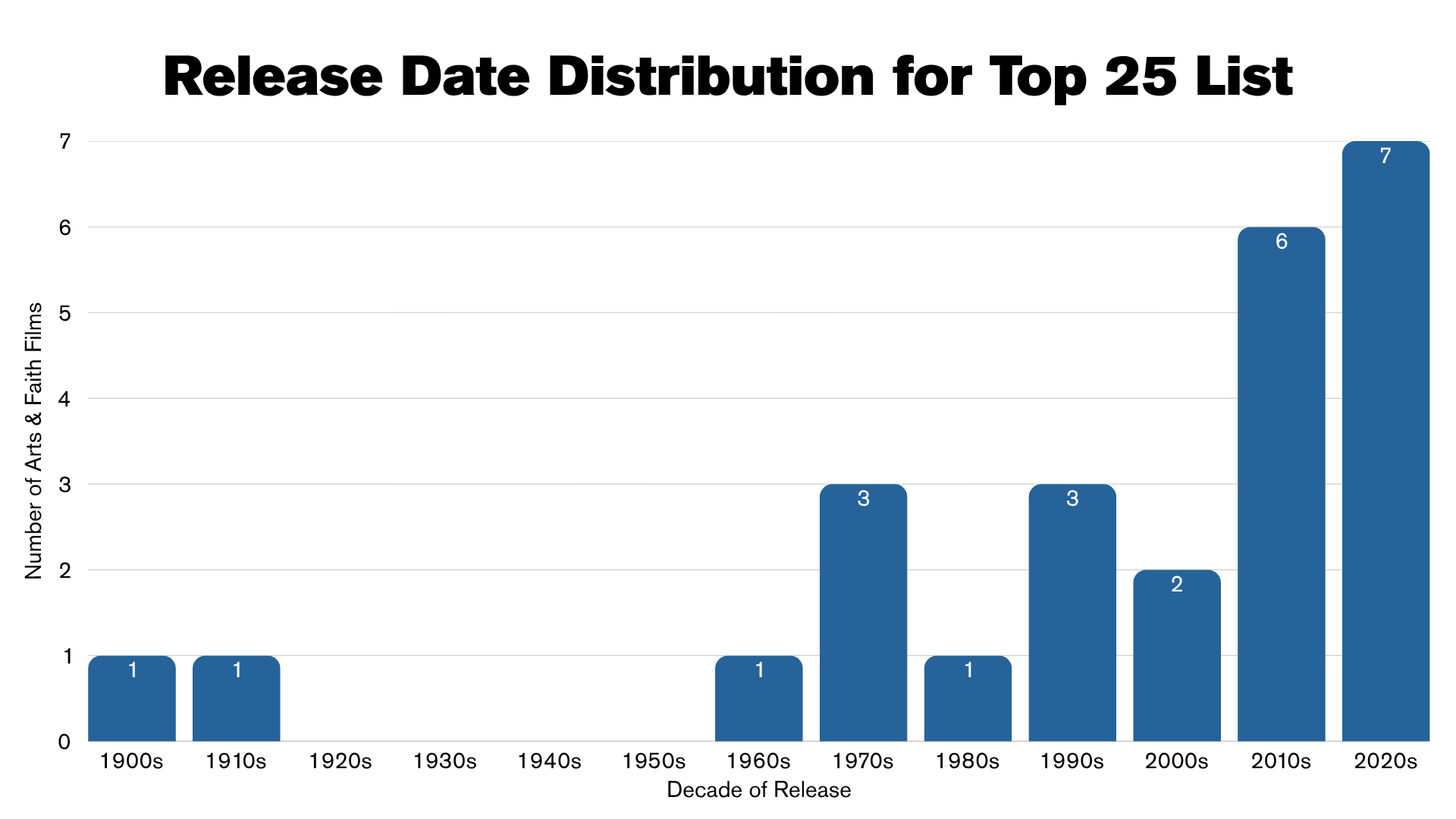
Despite the lack of era diversity, the women-directed list shows increased representation in other unique ways for Arts & Faith. 13 countries and six languages are represented on the list, including five films in French (20% of the list!) and two silent films. The group’s previous top 25 list (Crime and Punishment) contained only two non-English films and represented a mere six countries.
I won’t make any unsubstantiated claims, but that comparison does pose some interesting questions. Have countries outside America done a better job at giving women directing opportunities? Or did this group of jurors merely have a better appreciation of world cinema?
Lastly, while rating art is incredibly subjective, it’s interesting to look at the Letterboxd ratings for all Arts & Faith Top 25 lists:
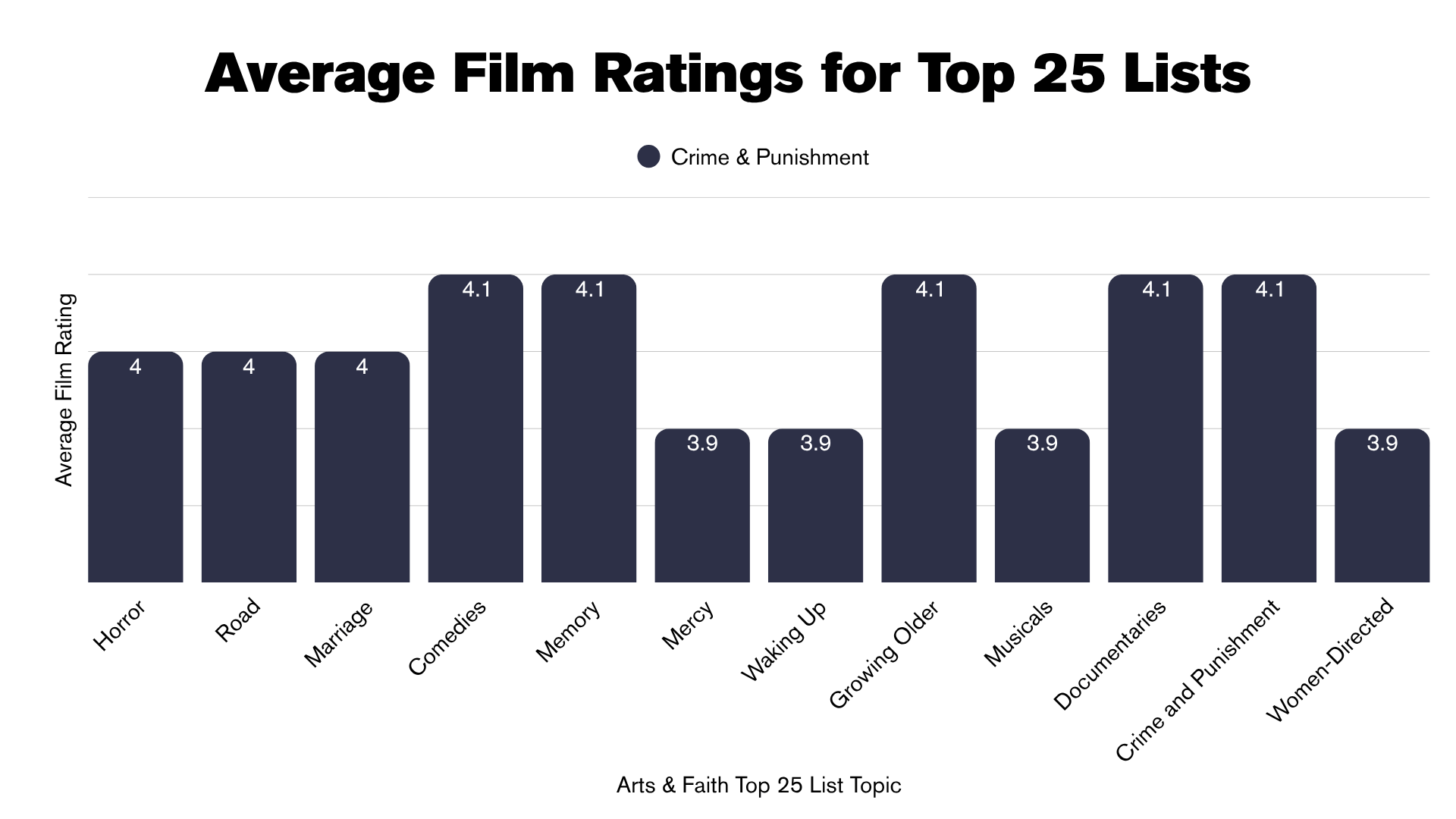
This year’s list is tied with three others for lowest average film rating. I’m unsurprised to see topics such as musicals on the lower end of the average, since they’re notoriously polarizing. But this may also point to why the barrier of entry on the Arts & Faith lists has been more difficult for women-directed films. Not only are women-directed films typically lesser seen, but the women-directed films Arts & Faith deemed the best have a 3%-5% lower average rating than most of our other top 25 lists.
In fact, only 20 films on the 2025 Top 100 list fall below a 3.9 rating (the average for our women-directed films). This trend extends to the musicals list, which shares a similarly lower average and claims only four spots in the 2025 Top 100.
I hope it goes without saying I realize Letterboxd isn’t the be-all and end-all of a film’s worth. But I do think the ratings there reflect a general cultural consensus around a film. Film ratings aren’t an objective measure of why a film does or doesn’t make an Arts & Faith list, but they do paint a broadly interesting picture of what may influence list results.
Top Films Directed by Women
I may have sounded pessimistic earlier when discussing the list results, but there are undeniable triumphs from creating this list. I was introduced to nearly 40 films I’d never seen while researching and voting, and I’d imagine other jurors shared similar experiences. That alone makes this process a worthy endeavor, regardless of whether those viewings bear fruit in future lists or not.
Some of my favorite films made the list; others sadly didn’t make the cut. Lois Weber was the first American woman to direct a feature-length film, and I’m thrilled that film, Hypocrites (1914), earned the #16 spot. Weber was vocal about using filmmaking as a tool for evangelism, and Hypocrites does so in striking fashion.
The Prince of Egypt is among my favorite films of all time and, as mentioned previously, landed at #3 on the list. The #14 spot went to La Vie du Christ (1906), one of the earliest movies about Christ ever made, and almost certainly the first major biblical film directed by a woman. The scenes are shot almost as living portraits in which the camera barely moves, turning each viewer into a biblical witness.
In addition, here are a few of my favorite films that unfortunately missed the Arts & Faith list:
Ida Lupino’s The Trouble with Angels (1966) is an equal parts funny and heartwarming coming-of-age story about two new students causing a raucous at a boarding school run by nuns.
Elaine May’s A New Leaf (1971) is a laugh-out-loud romantic comedy in which a carefree playboy plots to marry and murder a wealthy botanist. It sounds ridiculous (and is), but it’s the embodiment of 1 Corinthians 1:18: “The message of the cross is foolishness to lost people.”
Kelly Reichardt’s Wendy and Lucy (2008) beautifully portrays themes of prodigals and the calling of the church community as a near-penniless drifter loses her dog while attempting to shoplift food for it. “A righteous man cares for the needs of his animal, but the kindest acts of the wicked are cruel.” — Proverbs 12:10
In Jennifer Kent’s The Babadook (2014), a single mother and her child are haunted by a monster from an eerie children’s book. I’ve rarely seen a film so effectively cover the inescapable and daily struggle with sin and grief.
No list like this is perfect, but it has been a joy over the last several years to participate in the Arts & Faith community and contribute to this process. While many films in the Top 25 list aren’t new to Arts & Faith, I hope that having a dedicated list of spiritually significant films directed by women will prove useful to the film community at large, introducing them to underrepresented films, directors, and spiritual themes.