
Eternity - Christian Movie Review
Examining Perfection and Familiarity in the Afterlife of “Eternity”

This article first appeared on Film Fisher.
ANNA
“What do you think your soul is?”

LARRY
“I don’t know...I suppose it’s the perfect version of yourself.”

ANNA
“Nah, man. It’s just...you.”
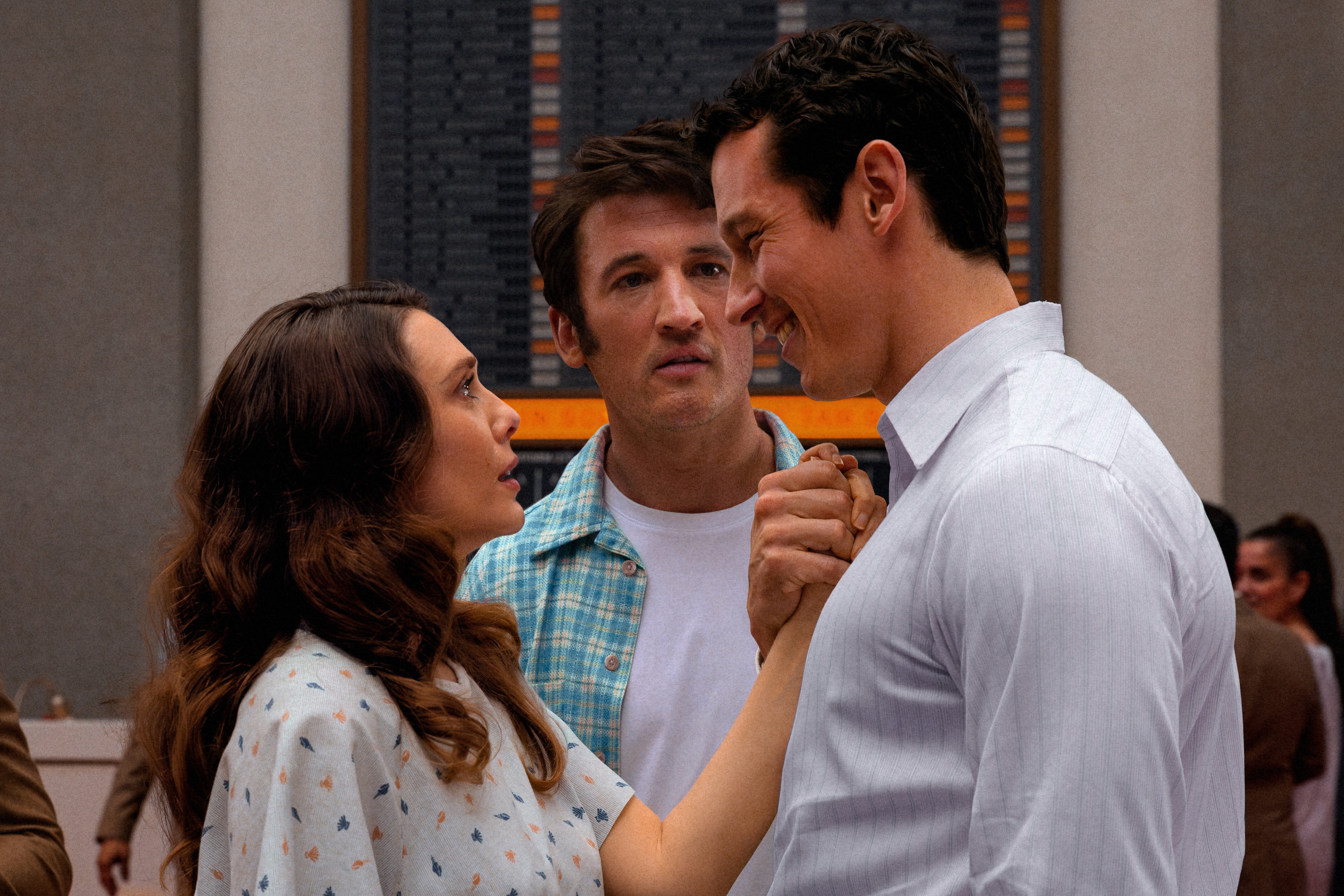
Nearly everyone in Eternity is obsessed with perfection. Picking the perfect place to spend eternity. Picking the perfect partner to spend it with. But with only one week to decide where to spend eternity, Joan is faced with the impossible choice between Larry, the man she spent her life with, and her first love Luke, who died young and has waited decades in the afterlife for her to arrive.
It’s a choice between what seems perfect and what feels familiar, and the film serves as a profound spiritual deconstruction of our modern obsession with perfection.
Thy Will Be Done
Eternity’s production design is a key component of communicating the film’s strange vision of the afterlife, the main waiting area a meticulously crafted blend of a mid-20th century corporate office and train station (it’s even called the Junction).
Everything in the Junction is built to create a facade of perfection. Rather than look out onto the heavens, the bedroom windows are backlit sheets of painted sky, swapped each morning and evening to simulate the transition from day to night. Popup banners crowd the Junction lobby, with salespeople trying to convince the newly deceased to go to their “perfect” eternity. This artifice establishes the film’s view of the afterlife as a product to be sold, a perfect experience designed to satisfy the consumerist soul.
This corporate aesthetic is often reminiscent of The Good Place, a television show also set in the afterlife, much of which is managed through cubicles and offices. However, while The Good Place questioned a merit-based system in which practically no one can be good enough to enter paradise, Eternity posits a different failure. The Afterlife Coordinator Anna explains to Larry, “Everyone gets an eternity. The good, the bad and the ugly.” But if that’s the case, why does there remain systemic unhappiness?
The flaw lies in the selection. Characters are made to choose a single, “perfect” location (and in Joan’s case a single, perfect husband) based on their own imperfect human desires. It is a paradise built on the “customer is always right” philosophy, ignoring the fact that the customer often wants the very things that will eventually make them miserable. “All I see is paint and it’s so boring! Museum-world is the worst!” one miserable man shouts as he’s arrested attempting to escape his chosen eternity.

In The Great Divorce (yet another story about purgatory and eternities), C.S. Lewis writes: “There are only two kinds of people in the end: those who say to God, ‘Thy will be done,’ and those to whom God says, in the end, ‘Thy will be done.’ All that are in Hell, choose it. Without that self-choice there could be no Hell.”
In Eternity, the residents are granted exactly what they think they want, yet this self-choice becomes their undoing. We see this in the various eternities marketed to the residents, like a tropical beach that’s overcrowded or a winter wonderland that Joan finds “a bit cold.” The film even mentions “discontinued” eternities that went “out of fashion... quite a few of them weren’t very PC by today’s standards.” These selections are flawed because human desire is not a reliable compass, and is often as artificial as the windows in the Junction.
You Cannot Understand Eternity
This tension between perfection and reality is also personified in the film’s leading trio. Luke (Callum Turner) is Joan’s first husband and appears perfect from all angles (by my count, of the film’s 26 uses of the word “perfect,” 18 of them are in reference to Luke). Larry, Joan’s second husband, calls Luke “the perfect ghost I could never compete with.” And it’s true. Luke gives off the appearance of the perfect husband because he is more memory than man.
The more the viewer gets to know Luke, the more we see the cracks in his facade. Each day he dyes his graying hair and shaves his beard. He looks at porn and has been hooking up with other women in the Junction. He cares more about meeting new people than deepening his existing relationship. Much like the various eternity locations people can choose, Luke is hollow, representing a seemingly perfect destination without any meaningful journey to get there.

Countering this is Larry, Joan’s second husband. Even in the afterlife, Larry is still his unfiltered self: irritable, anxious, and stubborn. Teller plays Larry with a grounded and relatably hilarious humanity that serves as a foil to Turner’s dream husband archetype. His lack of interest in the many questions of the afterlife is one of the film’s funniest and most telling character moments. As he puts it: “I’m dead and I haven’t once thought about the meaning of life. They’re all like, ‘this is it’ and I’m like ‘yup, makes sense to me.’”
“Ye cannot in your present state understand eternity. That is what mortals misunderstand. They say of some temporal suffering, ‘No future bliss can make up for it,’ not knowing that Heaven, once attained, will work backwards and turn even that agony into a glory” (The Great Divorce, C.S. Lewis).
Larry’s simple mindset makes him seem like the lesser option, and indeed, Joan initially chooses Luke, thinking he’ll make her happiest. But she quickly learns that the “perfection” offered by Luke, the winter wonderland eternity they choose, and the afterlife system as a whole, is just a facade.
The New Earth He Has Promised
The film’s climax rejects artificial perfection and embraces reality. Lewis argues once more in The Great Divorce, “Hell is a state of mind... every shutting up of the creature within the dungeon of its own mind - is, in the end, Hell. But Heaven is not a state of mind. Heaven is reality itself. All that is fully real is Heavenly.”
The Junction’s eternities are merely states of mind, artificial, flimsy, and tiresome. They offer a supposed escape from suffering, but in doing so, they remove the very context in which Joan and Larry’s love was forged. When Joan flees her perfect life with Luke to find Larry, she is choosing “reality itself,” as Lewis puts it. The eternity that Joan and Larry ultimately pick is their own neighborhood, Oakdale. An eternal, perfected, heavenly location that is rooted in the “fully real” life they shared.

Joan and Larry’s rejection of the Junction’s eternal vacation mentality is also reminiscent of N.T. Wright’s writing on heaven. Wright posits that God’s redeeming glory does not abolish the earthly, but perfects it through restoration:
“Part of the point of God’s saving his people is that they are destined not merely to enjoy a relaxing endless vacation in a place called heaven, but that they are designed to be God’s stewards, ruling over the whole creation with healing and restorative justice and love” (Surprised by Scripture, N.T. Wright).
When Larry and Joan step out of the Junction and into their familiar neighborhood world, they are witnessing a cinematic translation of this theology. Their destination is not a dream on a marketing brochure; it is the physical world they knew, now allowed to exist in its true, glorified, yet tangibly real state.
After an entire film—and life—searching for perfection, they’ve found it not in an ethereal, alien destination, but in the restoration of the good things they have already known. Looking out at a street that resembles the suburban road where they lived, Larry observes, “Well...looks like Oakdale.” To which Joan replies, “It’s perfect.”
“But we are looking forward to the new heavens and new earth he has promised, a world filled with God’s righteousness.” 2 Peter 3:13