
Lincoln, Nixon, and the Makings of a Faithful President
How Biopics Use the Beatitudes to Measure the Commander in Chief

The following was first published on Film Fisher.
The American presidency has long served as a primary vessel for the nation’s collective ideals, anxieties, and moral aspirations. 2026 is the United States Semiquincentennial (more commonly referred to as “America 250”), and the state of the presidential character remains a central fixture of the national consciousness. Cinema, in particular, has acted as a unique medium for defining the best and worst qualities of those that have held office.
While many biopics prioritize policy or political strategy, a distinct subset of presidential films provide insight into various presidents’ spiritual lives. From John Ford’s 1939 classic Young Mr. Lincoln to the upcoming Young Washington, filmmakers have consistently utilized biblical language to demonstrate the moral successes and failures of the nation’s leaders.
By examining the portrayals of faith in these films, a clear pattern emerges for qualities a president should (and shouldn’t) embody if they strive to be a Christian leader.
Young Mr. Lincoln focuses entirely on Lincoln’s life before politics, specifically his time as a lawyer defending two brothers who have been accused of murder. Henry Fonda delivers one of his best performances, making Lincoln feel immensely relatable and down-to-earth while also mythologizing him as a larger than life figure. Behind the camera, Ford furthers this depiction, placing the camera beneath Lincoln to emphasize his height as Fonda towers over the rest of the cast. Even Alfred Newman’s score is effective in humanizing the character.

Lincoln is universally regarded as one of America’s best presidents, so it’s no surprise that he’s depicted with such reverence and likability here. But the specific qualities Ford highlights are admirable and explicitly Christian traits. Lincoln is an advocate for the underrepresented, speaking to the masses about the importance of honesty, kindness, and fairness. The film’s best scene comes far before Lincoln’s time in court, when he simply asks a riotous crowd to show mercy, a speech that feels eerily prescient (though in reality, simply timeless) in today’s divided world.
“Trouble is when men start taking the law into their own hands, they’re just as apt, in all the confusion and fun, to start hanging somebody who’s not a murderer as somebody who is. Then the next thing you know they’re hanging one another just for fun, till it gets to the place where a man can’t pass a tree or look at a rope without feeling uneasy. We seem to lose our heads in times like this. We do things together that we’d be mighty ashamed to do by ourselves. ‘Blessed are the merciful, for they shall obtain mercy.’”
With that single speech, the film provides a wonderful reference point for the Christian virtues most valued in a president. Lincoln in the film models the beatitude he quoted, and in practicing law is focused on justice and righteous judgement.
A focus on justice and advocacy is a characterization modeled consistently across film portrayals of the 16th president. Lincoln (2012) is one of Steven Spielberg’s finest works, with a performance for the ages by Daniel Day-Lewis and a perfect Copland-esque score by John Williams. The film covers the final four months of Lincoln’s life and his efforts in those months to abolish slavery, a subject in and of itself that mirrors Young Mr. Lincoln’s commitment to justice and fairness.
The biblical merits of Lincoln’s fight are perfectly encapsulated by the closing scene, a flashback to his second inaugural address containing three biblical references:
“As was said three thousand years ago, so still it must be said “the judgments of the Lord are true and righteous altogether.” With malice toward none, with charity for all, with firmness in the right as God gives us to see the right, let us strive on to finish the work we are in, to bind up the nation’s wounds, to care for him who shall have borne the battle, and for his widow and his orphan, to do all which may achieve and cherish a just and a lasting peace among ourselves and with all nations.”
These qualities aren’t exclusive to Abraham Lincoln either. Amistad (1997) is another Spielberg film focused on a former president’s abolitionist efforts. The film follows a Supreme Court battle after Mende tribesmen abducted for the slave trade managed to gain control of their captors’ ship, only to be found and captured by the U.S.
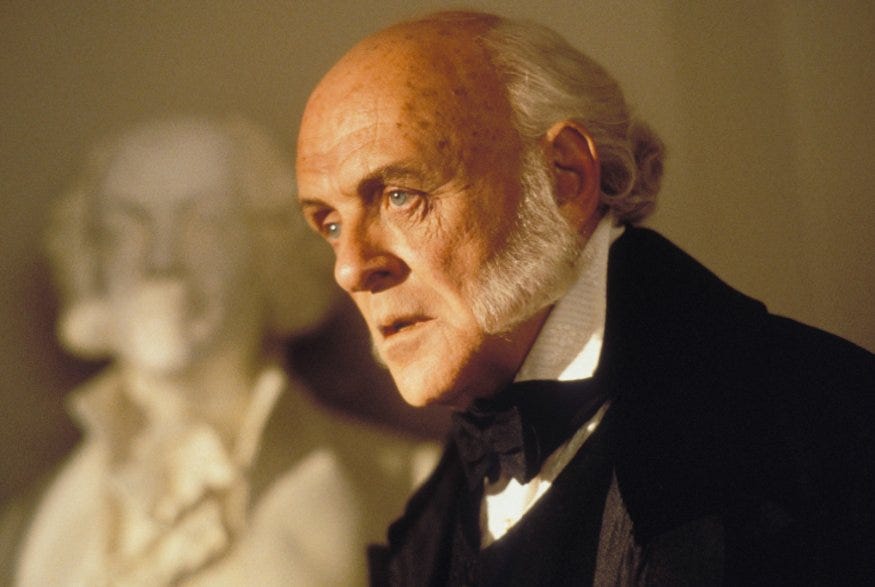
While Amistad suffers when compared to Spielberg’s surrounding work (released between Schindler’s List and Saving Private Ryan), it serves as an emotional and beautifully shot legal drama, with top tier performances from Anthony Hopkins and Djimon Hounsou.
Hopkins portrays John Quincy Adams after his presidency when he was practicing law (were all great presidents lawyers?). While initially hesitant to serve as defense attorney and ruin his image as a moderate, Adams is eventually persuaded to help those “without hope” such as the Africans on trial.
“What are we to do with this embarrassing Declaration of Independence?” Adams mockingly asks. “‘All men are created equal ... unalienable rights ... life, liberty and the pursuit of happiness?’ I have a modest suggestion -- why not just tear it up?”
In just a few films, a clear picture is forming for what filmmakers seem to believe is the heart of a good president from a biblical standpoint. A good president should be an advocate for those that lack one. A good president should be both fair and merciful. A good president should bind up the nation’s wounds, care for the widow and orphan, and strive to achieve peace (though that may mean righteous conflict).
Of course, we can learn just as much about what makes a good president by observing what makes a flawed one.
Oliver Stone’s Nixon (1995) stars Anthony Hopkins yet again, this time as the 37th president, and from the beginning frames his deficiencies through a biblical lens. The film’s opening text is Matthew 16:26, “What good will it be for a man if he gains the whole world, yet forfeits his soul?”
Much focus is given to Nixon’s childhood in the film, with his Quaker mother frequently warning him to stay focused on the Bible and not on worldly things. When a reporter later asks his mother if Nixon would make a good president, she responds unsmilingly, “...if he’s on God’s side, yes.”
The film provides viewers with a sympathetic, yet unflinchingly brutal look at Nixon, a man conflicted in his faith, his mission, and his duty. When his Chief of Staff warns about obstruction of justice, Nixon bites back, “It’s got nothing to do with justice. I suppose you thought the Presidency was above this sort of thing.” While Lincoln fought for justice, Nixon here finds it a nuisance.
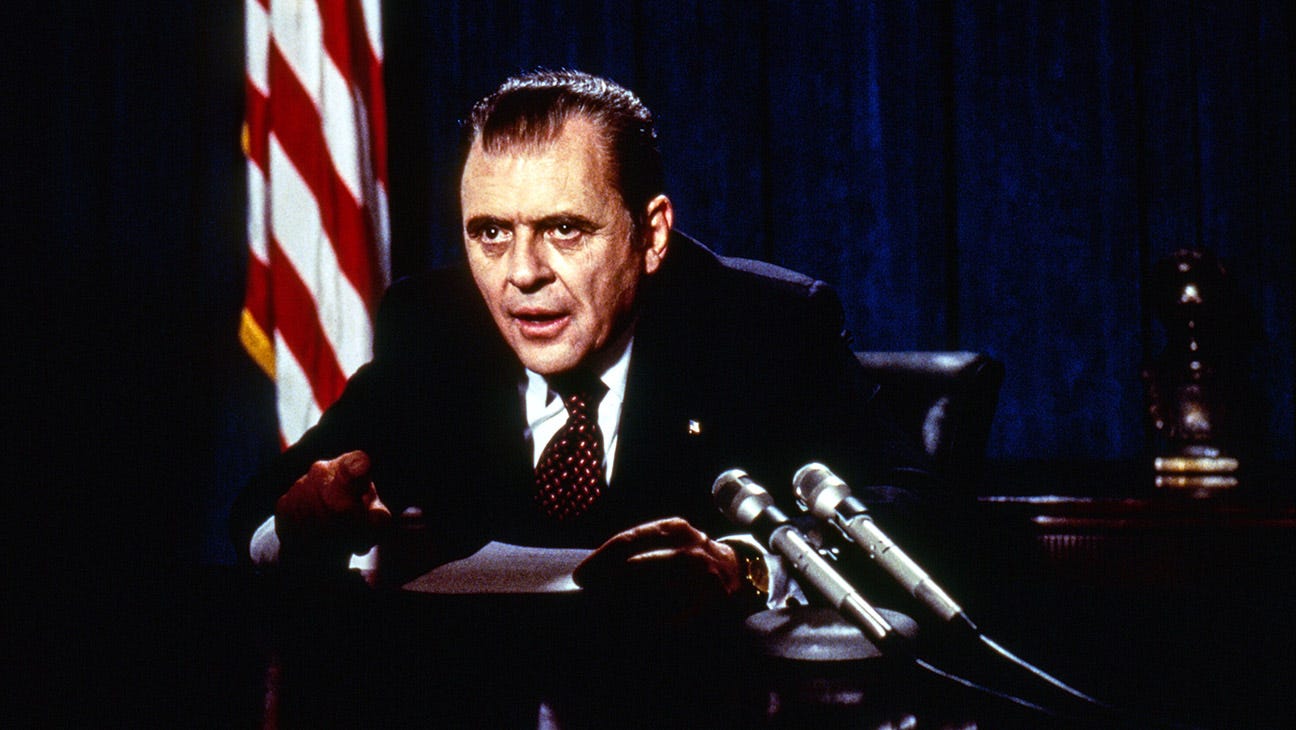
The film makes clear that Nixon considers himself a Christian, but his faith has not manifested in his works. One pivotal scene depicts Nixon attempting to connect with youth visiting the Lincoln Memorial, only to digress into admonishment. “Ending the war and cleaning up the air and the cities, feeding the poor ... none of it is going to satisfy the spiritual hunger we all have, finding a meaning to this life.” He knows that faith in God will satisfy the country’s spiritual hunger, but has somehow failed to connect the fact that a faith lived out means ending the war and feeding the poor.
My friends, what good is it to say you have faith, when you don’t do anything to show you really do have faith? Can this kind of faith save you? If you know someone who doesn’t have any clothes or food, you shouldn’t just say, “I hope all goes well for you. I hope you will be warm and have plenty to eat.” What good is it to say this, unless you do something to help? Faith that doesn’t lead us to do good deeds is all alone and dead! – James 2:14-17
If one looks again at the beatitudes, Nixon’s presidency is portrayed in Stone’s film as a failure of Matthew 5:5, “Blessed are the meek, for they will inherit the earth.”
Viewing the role of president (or any politician) as a Christian vocation is fraught with danger, too easily warped into the idea that those politicians speak for God or should form a theocracy. But at the same time, if Christians are striving to make God’s kingdom come “on earth as it is in heaven,” then Christian leaders should seek to lead in a Christlike way.
Countless films demonstrate this presidential imperative, not to force Christian hegemony on the United States, but to lead in such a way that embodies the values Christians themselves should embody.
Path to War (2002) shows Lyndon B. Johnson agonizing over his administration’s escalation of the Vietnam War, repeatedly saying he wants peace (“Blessed are the peacemakers,” Christ would warn him), but forced deeper into the conflict. LBJ (2016) focuses more positively on Johnson’s Civil Rights activism, embodying the same advocacy seen in films such as Lincoln and Amistad.
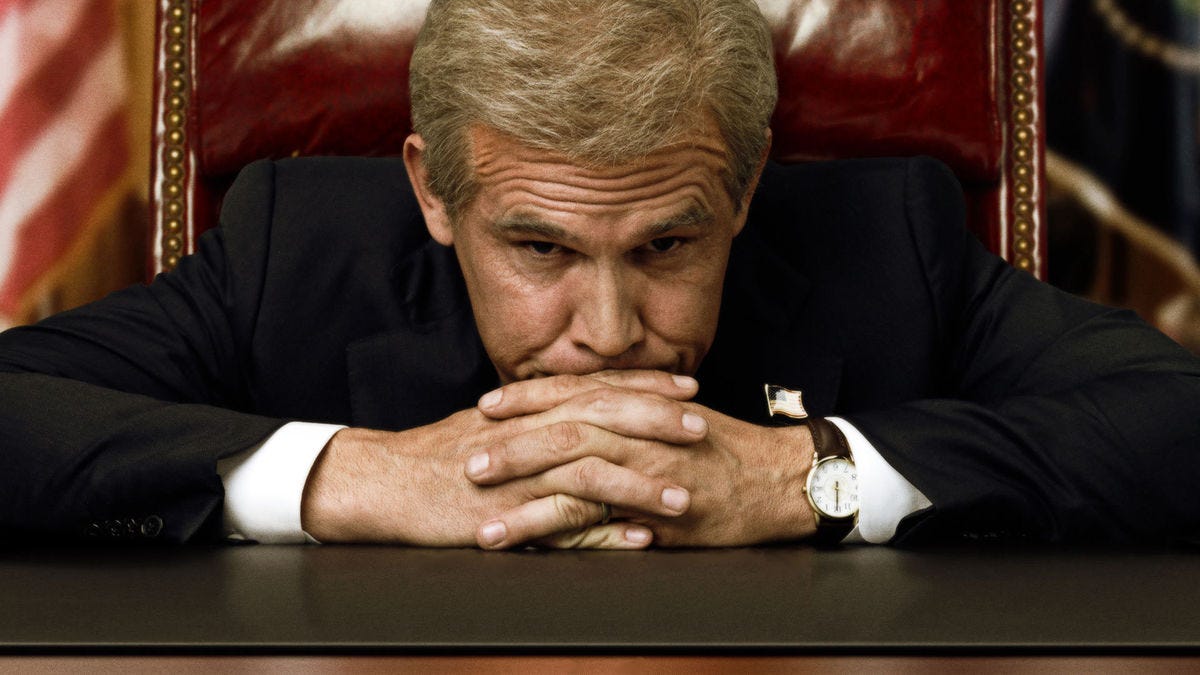
The Front Runner (2018) shows charismatic senator Gary Hart’s presidential campaign fall apart after allegations of an extramarital affair. And Oliver Stone’s W. (2008) shows George W. Bush’s conversion to Christianity and subsequent sobriety as almost a prerequisite to becoming fit for the presidency.
This cinematic trend certainly does not argue for a return to the Moral Majority era of the late 20th century. However, it highlights a cultural nostalgia for a leadership model (however fictionalized it may now be via film) grounded in recognizable moral guardrails.
In Jesus and the Powers, Michael Bird and N.T. Wright lay out the way citizens and leaders alike should properly live out God’s will on the political stage. Fascinatingly, it mirrors exactly what can be found in Young Mr. Lincoln and the other films mentioned above:
God wants his world to be properly run, but the standard for ‘properly’ is that of Psalm 72: the wise, healing justice of the Messiah’s rule, caring for the poor and needy, confronting and overthrowing the bullies and the oppressors, opening the way for the whole world to be filled with God’s glory.
That final phrase might be the most important. While nearly every president has claimed Christianity as their religious affiliation, a president doesn’t have to be a Christian. But when voting for and evaluating leaders, Christians should be asking a simple question: is this person opening the way for the world to be filled with God’s glory?