
Forrest Gump's Musical Destiny
Alan Silvestri's score illustrates the tension between accident and destiny.

The following was first published on Film Fisher.
Last year I had the pleasure of seeing Alamo Drafthouse’s 30th anniversary re-release of Forrest Gump. Winner of 6 Academy Awards, including Best Picture, Robert Zemeckis’ Forrest Gump follows its titular character, an Alabaman who “happens into one memorable experience after another through a panorama of American history from the 1950s to the present.”
I’m a film composer, and as I sat in theaters paying special attention to Forrest Gump’s musical score, I realized that composer Alan Silvestri uses his music to embrace the film’s core theme of destiny versus “accidents.” He frequently oscillates between intentional thematic association (using a musical motif to clearly represent a person or feeling) and incidental thematic association (using the same musical motif over seemingly unrelated scenes).
Of course, nothing in film is really an accident ... or at least it shouldn’t be in the hands of a caring filmmaker. But Forrest Gump’s recurring musical elements reveal much about the film’s thematic intentions, and the music’s structure and placement contains quite a few lessons for Christians grappling with their own destiny.
Let’s dive into those musical motifs, and then break down what it all means.
Feather Theme
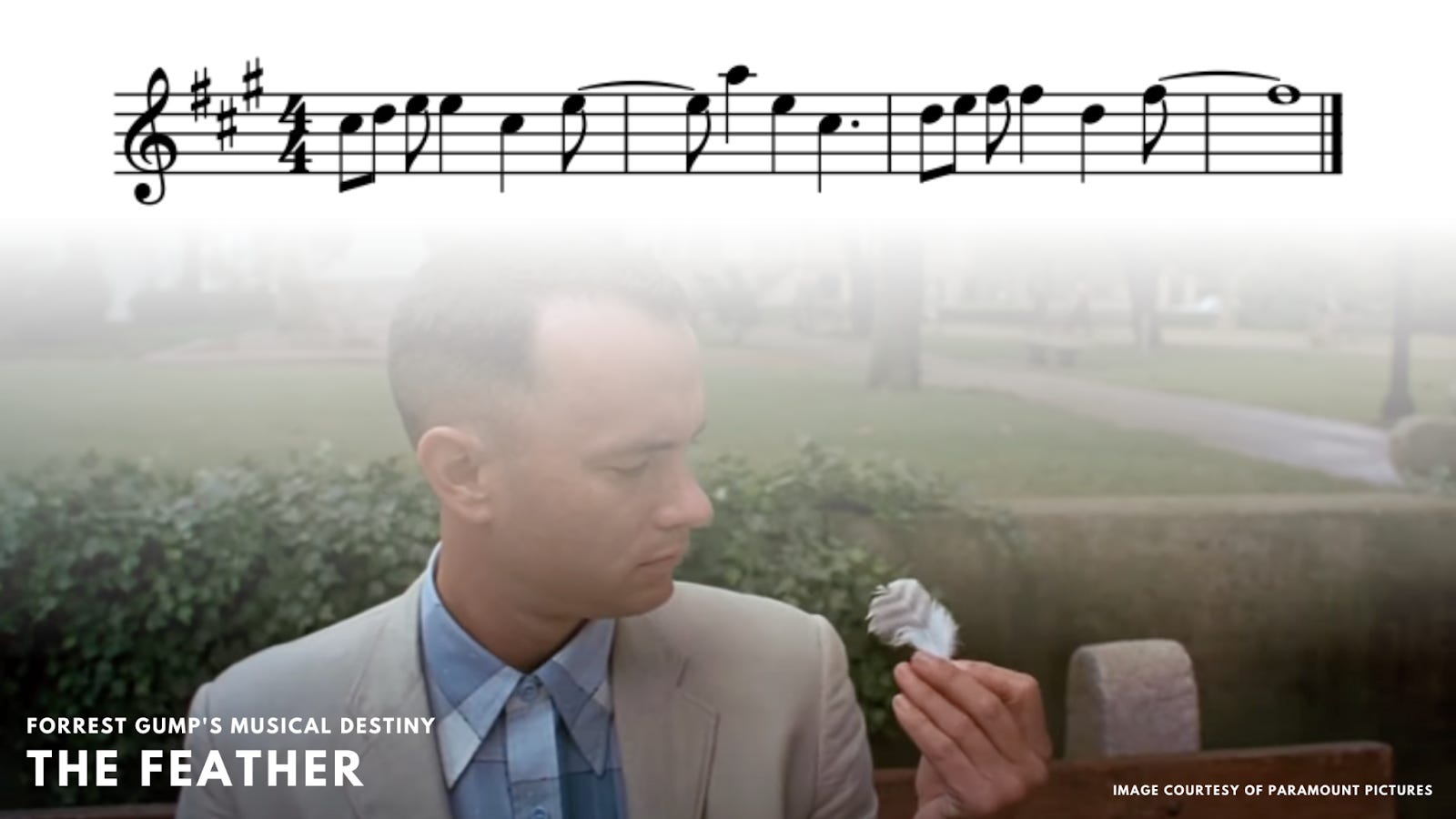
The feather motif is without a doubt the most recognizable music from Forrest Gump (thanks in no small part to the iconic nature of the scene itself). Given its popularity, it would be easy to assume this was the film’s main theme. But this famous melody only appears twice in the entire film: once at the beginning as we watch the feather flit across the sky and land at Forrest’s feet, and once at the end as the feather leaves the ground, flying up to the sky once more.
The feather itself represents the film’s intertwining of destiny and free will, the feather randomly floating around, but somehow ending up right at Forrest’s feet. And the melody of the musical motif conveys this incredibly well. Look above at how the melody goes up and down, sometimes step by step, sometimes leaping and falling, sometimes hitting the beat, sometimes arriving off rhythm. It’s a perfect musical representation of mixing randomness and purpose together, creating a musical box of chocolates (you never know what you’re going to get).
It’s an interesting choice by of the filmmakers to bookend Forrest Gump with this music, but not use it anywhere else. The melodic construction and its visual association with the feather makes it a perfect motif to bring back every time Forrest contemplates his life or discusses destiny. Why not use it further?
Perhaps the motif is so memorable and closely associated with the feather, that it made the most sense to only use it at the beginning and the end. Much like the Star Wars main theme (another famous musical track that is also rarely heard outside of the opening and end credits of each film), perhaps the feather motif was best for setting the tone of Forrest’s journey, rather than accompanying him on that journey.
So what music does accompany Gump throughout his life? I’ve noticed a three-note pattern that appears in a variety of ways all over the film. Those three notes embody the holistic concept of destiny — destiny in our triumphs, in our hardships, and in our relationships. I’ve highlighted these notes in yellow in each of the sections below so they’re easier to spot.
Triumphant Destiny
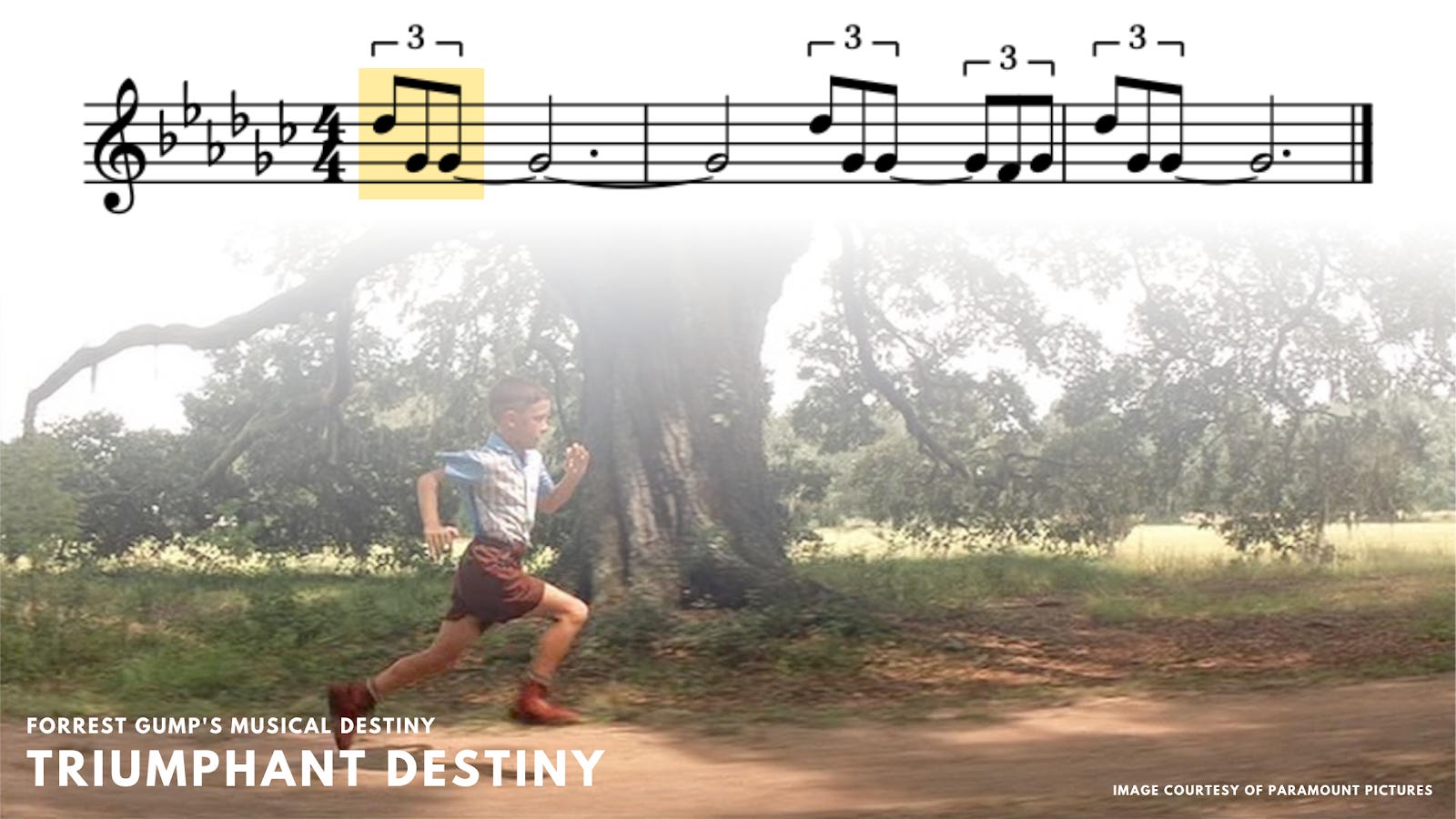
The “Triumphant Destiny” motif is one of the easiest to spot in the film. We’re introduced to this lively and joyous music as Forrest runs to escape bullies, the braces falling off his legs as he smiles and takes off in amazement. The melody is played on triumphant brass instruments as strings accompany it with a flurry of sound.
We get variations on the same theme as Forrest comically becomes an All-American football player (this time utilizing more of a marching band instrumentation), and later when Forrest decides to run across the country. These are the most triumphant moments of the film, which makes it easy to label this theme as such. Every time we hear that theme kick in, we know something exciting is in store for our protagonist.
Silvestri also uses this musical association to hint at future success. Just listen to the cue “That’s My Boat.” Forrest has been unsuccessful in his shrimping endeavors, and his boat comically crashing into the dock as the scene comes to an end isn’t an encouraging visual cue for the future. But as he sees Lieutenant Dan and erratically swims to shore to meet him (John 21:7, anyone?), we hear Silvestri hint at the “running” theme in the score. It’s not a full blown rendition, but the slow swells of the music build into the Triumphant Destiny motif’s joyfully bouncing strings, hinting that maybe, just maybe, this unlikely pair will find success in the shrimping business. And they do.
Whether foreshadowed or in the moment, this aspect of destiny is meant to evoke feelings of happiness and victory. When we hear this musical motif, we can expect life’s best moments in the film.
Melancholy Destiny
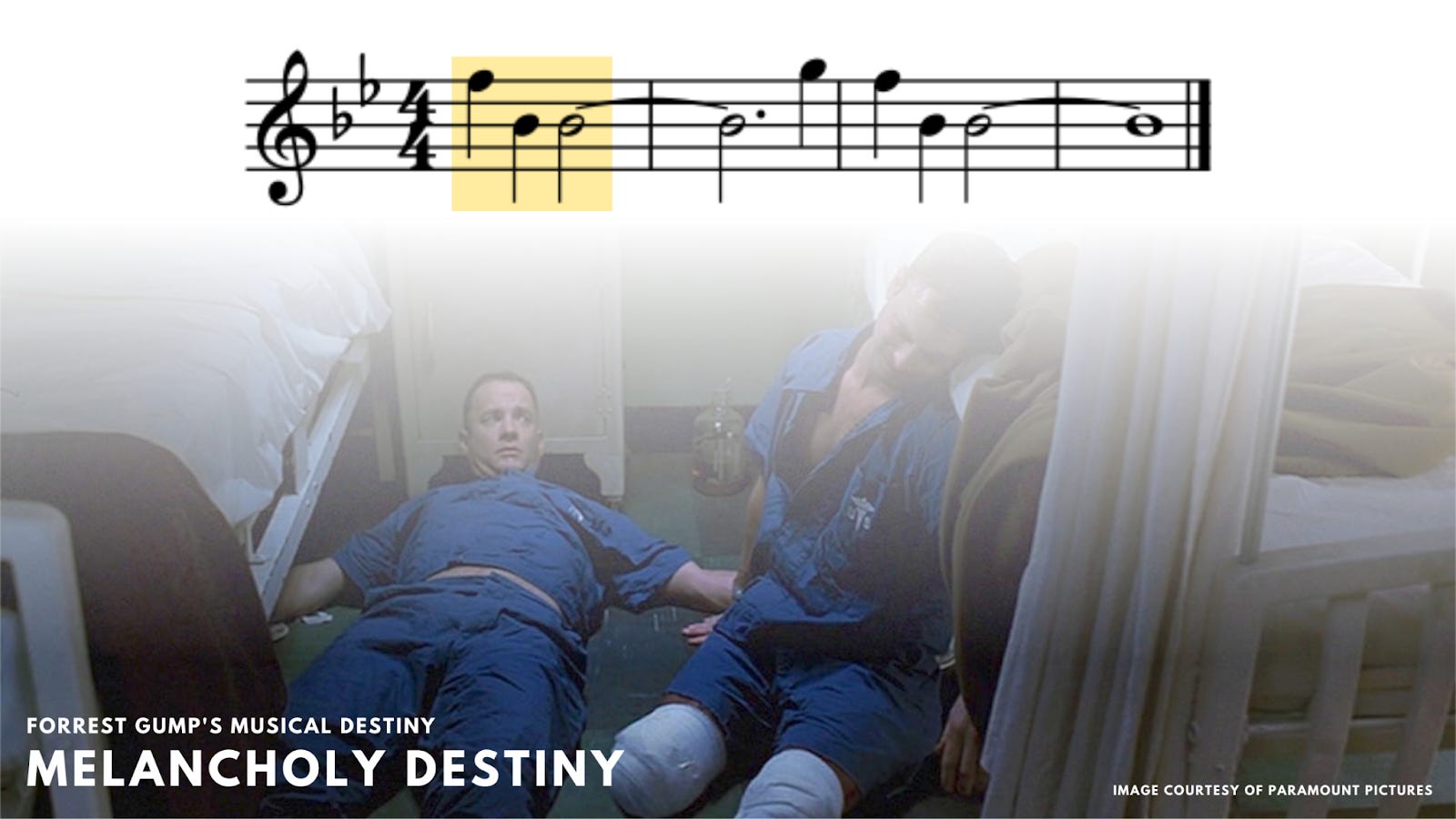
The Melancholy Destiny motif contains a much slower tempo and subtler orchestration, which makes it easy to miss its striking resemblance to the Triumphant Destiny motif, both containing a single high note falling down a perfect fifth to two repeated lower notes.
Though it’s hinted at briefly in moments such as “Pray With Me” and “They’re Sending Me to Vietnam,” this motif is more noticeably introduced when a despondent Lieutenant Dan bemoans both the loss of his legs and the loss of his perceived purpose, a sacrificial death in the war. “We all have a destiny,” he cries. “Nothing just happens, it’s all part of a plan. I should have died out there with my men! But now, I’m nothing but a cripple.”
With its melodic similarities to the Triumphant Destiny motif, this music’s use in the film reveals itself as a dark mirror to the triumph and joy of Forrest’s successes. Despite being in many of the same situations, Forrest seems to always find luck and success, while other characters such as Lieutenant Dan or Jenny find only (perceived) loss.
This theme returns to start the aforementioned “That’s My Boat” scene, and occurs at multiple other points such as “I Never Thanked You,” when Lieutenant Dan seems to have finally made peace with the outcome of his life). The mood and instrumentation of this motif lends itself to introspection. How has the perception of destiny shaped these characters’ lives for better or for worse? Where have they perhaps missed destiny’s hand at work, and are they reckoning with its pattern over time?
Love and Loss
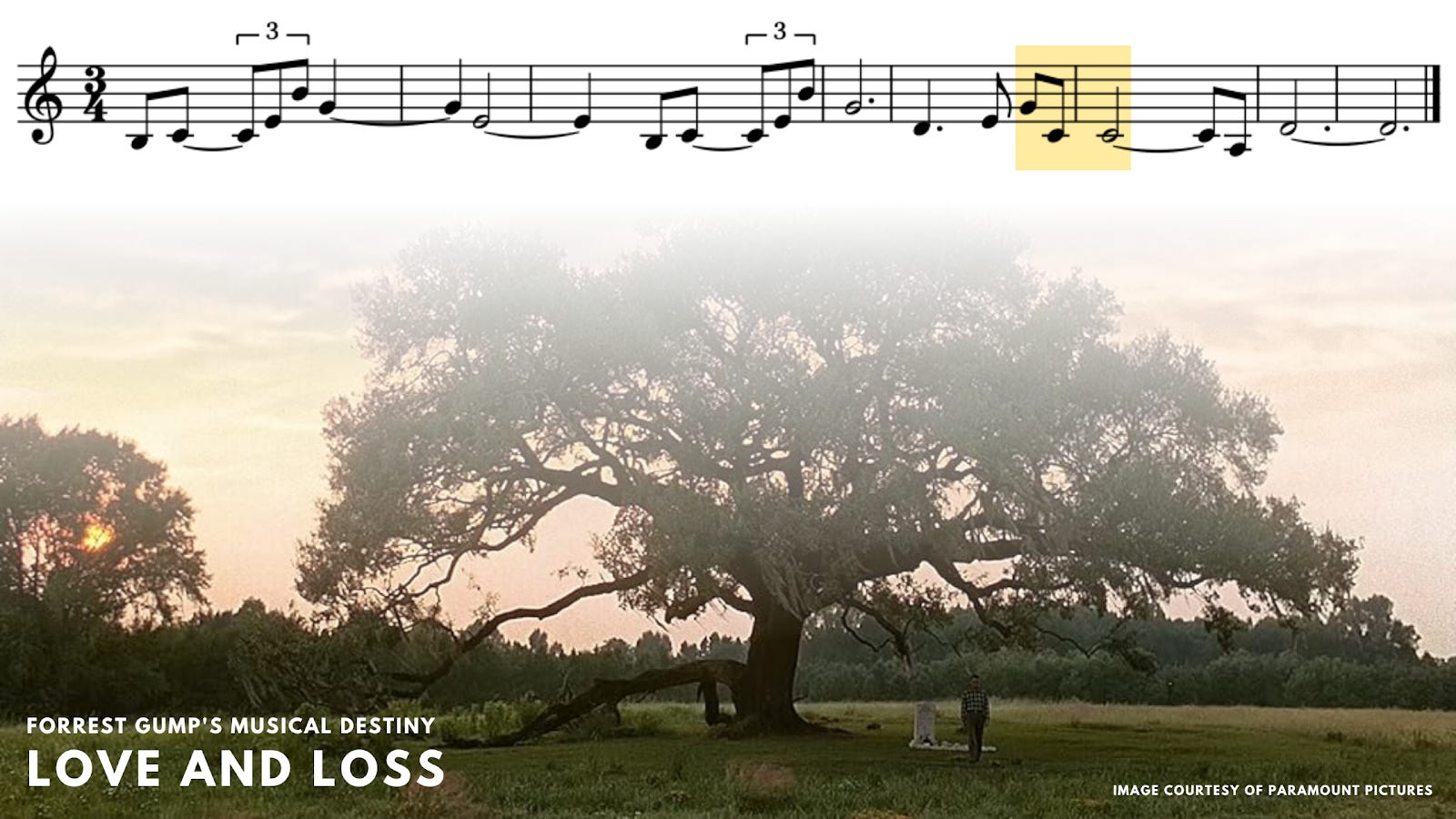
The Love and Loss motif is used in the film across a variety of scenarios and characters, but is always used to represent Forrest’s relationships (his mother, Jenny, his son), and the eventual loss of some of those relationships.
So how does this relate to destiny? Via the incorporation yet again of the destiny notes, highlighted above. That makes three frequent and recurring musical motifs that all incorporate the destiny pattern, reinforcing destiny’s significance across the entirety of Forrest’s life.
We’re introduced to the motif when Forrest meets Jenny for the first time on the school bus, and that music follows his relationships throughout the film, from Jenny’s return to the death of Forrest’s mom to Forrest meeting his son for the first time (an acting masterclass from Tom Hanks).
While the three-note destiny motif is located here within a much larger melody, its presence still speaks volumes. Destiny in this context isn’t just about life’s triumphs and losses, it is about the people that are placed in one’s life, whether seemingly random or intentional, that have an unmistakable impact on life’s journey.
What Does It All Mean?
It’s always interesting to break down a musical score, but you may still be asking yourself: why does it matter? What does it all mean for a filmgoer, let alone a Christian?
“Our destiny is only defined by how we deal with the chance elements to our life,” Tom Hanks reflected. “Here is this [feather] that can land anywhere and it lands at your feet. It has theological implications that are really huge.”
Hanks isn’t wrong about the theological implications. What humans may view as mere accidents or chance are often instances of God working in our lives.
This means the film, the film’s score, and on a broader scale, the Christian life, is about finding purpose in the chaos and meaning in the randomness. It means making sense of musical notes and motifs that seem to have no reason to show up where they do. It means finding God’s will for the future even if one cannot seem to find His presence in the present.
Many critics lambast the bizarre moral implications of Forrest Gump, a story which could be positioned as a simple-minded man succeeding with little-to-no thought given to his actions while those around him that seek independence and strive for change are met with failure and even death. Is the film really saying that an ignorant yes-man is the only type of person that can succeed in our country? That reading is a fair one (and carries with it its own deeply tragic implications), but a Christian reading paints that picture in a far kinder light.
Martin Luther argued “Man, before he is renewed into the new creation of the Spirit’s kingdom, does and endeavours nothing to prepare himself for that new creation and kingdom, and when he is re-created does and endeavors nothing towards his perseverance in that kingdom; but the Spirit alone works both blessings in us, regenerating us, and preserving us when regenerate, without ourselves. By ‘free will,’ not one person can be saved. But by free grace, many will be saved.” (On the Bondage of the Will, 1525)
In other words, every good and perfect gift in the film – and in our own lives – comes from God. (James 1.17) As critics so readily point out, Forrest’s triumphs are certainly not of his own works, lest he should boast. On the contrary, every person in the film that does try to achieve things by their own works fails. It’s understandable to take issue with this story and thematic choice, but as a parallel to the Christian life, it’s reassuring.
And this assurance comes via the three-note destiny pattern that appears in nearly all of Forrest Gump’s musical motifs, pointing to destiny’s work, which is God’s work, in everything. Destiny’s music is present in Forrest’s triumphs, in Lieutenant Dan’s and Jenny’s melancholic lowpoints, and in every relationship of the film, and points to the interconnectivity of each of those disparate elements in Forrest’s life.
Even the music’s arrangement and instrumentation points to lessons for the Christian life. It’s very easy to recognize the destiny notes in their “triumphant” form. But it’s much harder to recognize those notes when they’re subtly played in their “melancholy” form, or when they’re mixed into the larger melody of love and loss. How much easier is it to see God’s handprint in life’s triumphs than in its hardships? Or even through the rollercoaster of emotions that human relationships can bring? Nevertheless, He is at work in it all, just as those three notes are at work in all of Forrest Gump’s score.
Reflecting on his journey at the end of the film, Forrest sums up the story’s theme: “I don’t know if we each have a destiny, or if we’re all just floating around accidental-like on a breeze, but I think maybe it’s both. Maybe both is happening at the same time.”
The quote poignantly explains the battle that we all face in our search to find a purpose and identity. And when I find myself reflecting on Biblical arguments for free will and predestination, I ultimately arrive each time at Forrest’s fair, if perhaps unsatisfying, answer... “maybe it’s both.”