The following was first published on Film Fisher.
“You think you can just build a prison of memories to lock her in?”
In Inception, Cobb’s personal dream sessions break every one of his rules for dream worlds. He warns others not to base dream worlds on reality, stating “building dreams out of your own memories is the surest way to lose your grip on what’s real and what’s a dream.” But every time he dreams, the dreams are built from real memories of his dead wife, Mal, and their young kids.
Inception can be a complicated film to explain, but at its most basic level, the film is about Cobb, a thief who steals information by entering his targets’ dreams – their subconscious. Wanted and on the run, a client offers to erase Cobb’s criminal history and reunite him with his children if he’ll instead plant an idea in someone’s subconscious, a process called inception.
Cobb’s status as a fugitive due to his past as a criminal provides a constant external threat to his mission, but these external forces are also mirrored internally as he’s haunted in his dreams by the malicious memory of Mal, who is sabotaging missions and threatening his grip on reality. Whether in the real world or in his dreams, Cobb can’t escape the past and can’t stop looking back at what might have been.
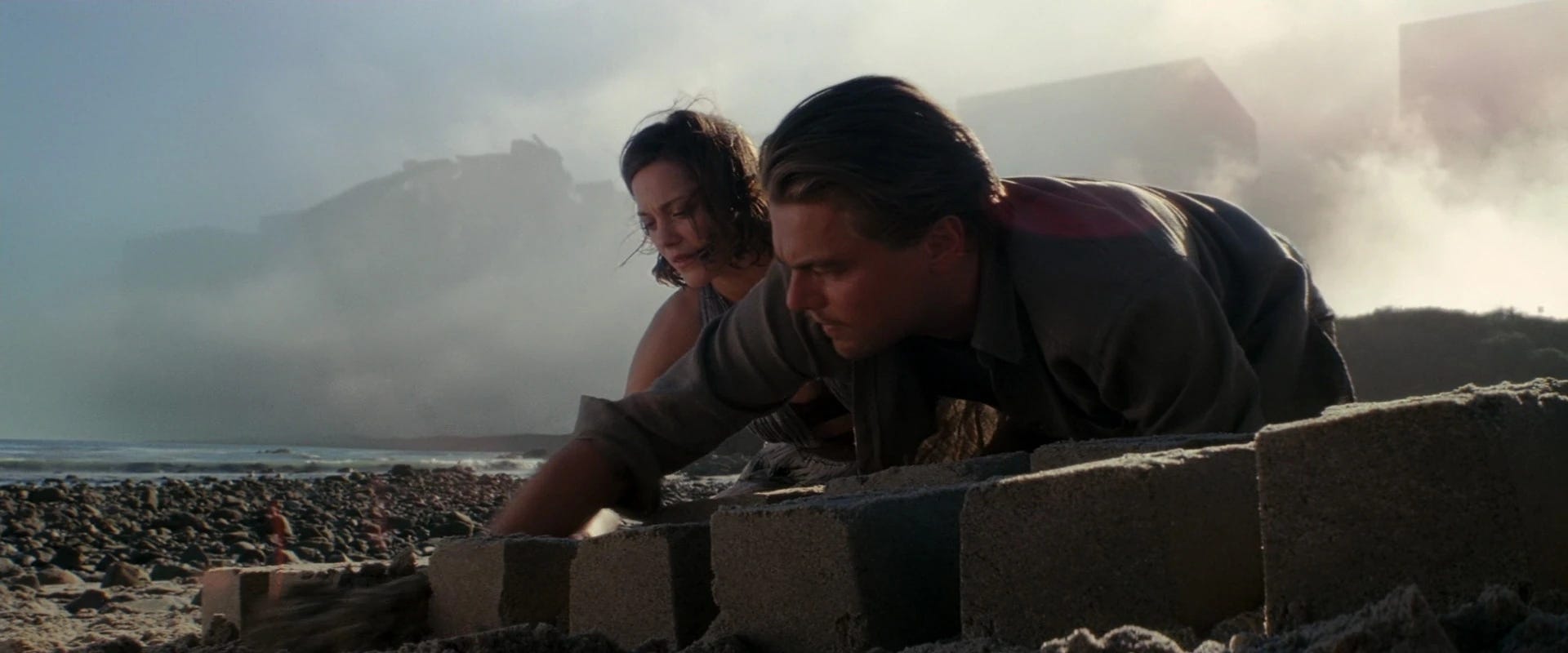
This culminates in a showdown with Mal several dream layers deep (Limbo), as she threatens to ruin his final mission and any chance for a future of freedom. It’s here that Cobb is faced with a choice: Stay with Mal in the crumbling hellscape of his past memories, or let go, move forward, and seek a fresh start.
To the audience this seems like an easy decision: just move forward. But as stories have warned us for millennia, looking back is a far more tempting proposition.
A Pillar of Salt
While only taking up a portion of two chapters in the Bible (Genesis 18-19), Christians and non-Christians alike are likely familiar with the story of Sodom and Gomorrah’s destruction, where Lot’s wife was turned to a pillar of salt. Angels come to save Lot and his family from the cities’ destruction, warning them, “Run for your lives! Don’t even look back.” But Lot’s wife couldn’t resist. Lot’s Wife, a poem by Russian-Soviet poet Anna Akhmatova, is particularly memorable for its description of her temptation and demise:
And the just man trailed God’s shining agent,
over a black mountain, in his giant track,
while a restless voice kept harrying his woman:
“It’s not too late, you can still look backat the red towers of your native Sodom,
the square where once you sang, the spinning-shed,
at the empty windows set in the tall house
where sons and daughters blessed your marriage-bed.”A single glance: a sudden dart of pain
stitching her eyes before she made a sound...
Her body flaked into transparent salt,
and her swift legs rooted to the ground.
Jesus recalled this story in his teachings, warning his followers that when the Son of Man appears “no one on a rooftop should go down into the house to get anything. No one in a field should go back to the house for anything. Remember what happened to Lot’s wife” (Luke 17:30-32). In Inception, it’s easy to assume that Mal is the analogue to Lot’s wife, with Cobb being Lot. But Cobb much more closely resembles Lot’s wife, paralyzed like a pillar of salt by his inability to move on.
As biblical scholar Theodor Gaster puts it, “Within the dramatic context of the story this means, of course, that they must set their faces hopefully toward the future, not nostalgically toward the past” (Myth, Legend and Custom in the Old Testament, 1969). But there’s much more nuance to the lessons of Inception and Lot’s wife than simply forgetting the past.
Christian Memory
Christianity does not teach that forgetting the past is good. In fact, remembering rightly is essential. “Do this in remembrance of me,” Christ instructs his disciples (Luke 22:19). Israel cherishes the Exodus story, with even baptism itself serving as an ongoing “acting out” of God’s deliverance from Egypt. The psalmist remembers the deeds and miracles of the Lord (Psalm 77:11).
So memory itself isn’t the danger. The danger is how we remember, clinging to the past as though you could – or should – live there again. It turns memory into a refusal to accept the present, a grasping after what God has already asked us to release, and a substitute for trust in God’s future.
This is Lot’s wife, practically saying, “I must have what I’ve lost. If this is the price of moving forward, I won’t pay it.” This is also Cobb’s version of Mal. He remembers her out of his own grief and guilt, not through pure love. His memory becomes an idol and as a result his dream sessions, no matter how hostile, become a world he would rather live in than reality.
Jesus tells a potential follower, “No man who puts a hand to the plow and looks back is fit for the kingdom of God” (Luke 9:62). The Wisdom of Solomon even calls the pillar of salt a sign that Lot’s wife “refused to believe.” This description clarifies what was already implied in the Genesis account and is emphasized by Christ: looking back when we’ve been called to trust in what’s ahead is a sign of disbelief.
Sadhu Sundar Singh succinctly and powerfully emphasized the Christian calling to look ahead in his hymn, I Have Decided to Follow Jesus:
I have decided to follow Jesus;
No turning back, no turning back.The world behind me, the cross before me;
No turning back, no turning back.
Past Destruction and Future Hope
As Inception reaches its end and we travel with Cobb deeper and deeper into the dream worlds, we see that Limbo greatly resembles a destroyed Sodom, as the screenplay poetically describes:
Ariadne lies in the SURF, STARING up at a CLOUDLESS SKY. A tremendous BOOM prompts her to look around her- URBAN BUILDINGS PILED right down to the water. The buildings are DECAYING, falling into the ocean like a GLACIER calving. Cobb WADES towards her through the shallow water. Ariadne looks up at the crumbling city around them.

ARIADNE
This is your world?

COBB
It was. And this is where she’ll be.
“This is where she’ll be” is a fitting moment of clarity for Cobb. It’s a recognition not just of Mal’s physical location, but that she is a piece of his past, crumbling around him. The past is the only place she can exist.

As he confronts Mal for the last time, he finally realizes it’s time to move on. It’s time to look away from the death, destruction, sin, and decay that defines his past and this Limbo world. “I miss you more than I can bear,” Cobb tells her. “But we had our time together. And now I have to let go.”
Inception and the story of Lot’s wife encourage us to strive for redemptive remembrance, a type of memory that fuels hope. Cobb’s entire arc is a battle between destructive and redemptive memory. His backward-looking memory traps him in Limbo, where he clings to his dead wife and the destroyed world they had built. His forward-looking memory seeks to reunite with his children and finally lets him leave illusions behind.
And in the film’s final moments, he saves Saito (the mission’s benefactor) in the same way, pleading with Saito’s memory of what was promised not as a way of looking back, but so they can move forward to the future. “I came back for you... I came to remind you of what you once knew... to take a leap of faith.”
Inception’s ambiguous ending is among the most famous in recent cinema history. Cobb, believing he’s back in the real world, spins a top that tells him if he’s awake or dreaming. But before he can get his answer, he sees his children and is so filled with joy that he abandons the top so he can embrace them.
The spinning top, left unresolved as the film cuts to black, leaves viewers with a tense uncertainty. Is he still trapped in a dream? Or has he made it back to the real world? But as it relates to Inception’s themes, this question doesn’t actually matter. Cobb’s character has overcome his inability to move on; he’s stopped looking back at a life of mistakes and is fully ready to embrace the future.
Lot’s wife looked back and lost her life.
Cobb finally looks forward ... and that promised future is all that matters.