
Moulin Rouge! and the Jukebox Gospel
How cultural literacy affects everything from film viewing to preaching.

Can I make a confession that might have my composer card revoked? I didn’t realize the songs in Moulin Rouge! were pop music for an embarrassing amount of its runtime. In the time since, it’s become one of my all time favorite films and I revisit it multiple times per year; but it was an odder journey to loving the film than director Baz Luhrmann likely intended.
You see, since I had no idea Moulin Rouge! was a jukebox musical (a musical that uses well-known, pre-existing popular music songs), I wasn’t bringing in the expected cultural literacy, which made understanding the film’s layers a greater challenge. Let’s break down my strange relationship with Moulin Rouge! and how the jukebox musical is a perfect modern equivalent of the cultural literacy the apostles used to spread the gospel.
A Modern Opera
Tonally, Moulin Rouge! is the closest a filmmaker has ever gotten to crafting a modern opera. There isn’t wall-to-wall music, but the spirit and tone of the film is operatic to a fault. The exaggerated performances, the manic editing, and the beautifully arranged music all work together to assault the senses and tell a timeless story. We’ll get to the music soon, but I’d be remiss not to briefly touch on those other components.
The operatic scale is evident in the acting, which manages a perfect balance between the theatrical and the sincere. It would be easy for the cast to downplay the craziness or to go so over-the-top that the tone purely comes off as silly. Instead, the actors find a perfect balance. Ewan McGregor turns on the schmaltz as Christian, but gives an earnest performance (I’ve never seen hopeless romance portrayed so effortlessly as the glimmer in his eyes), while Nicole Kidman’s Satine layers a nuanced performance behind the flirtatious front her character puts on at the club.
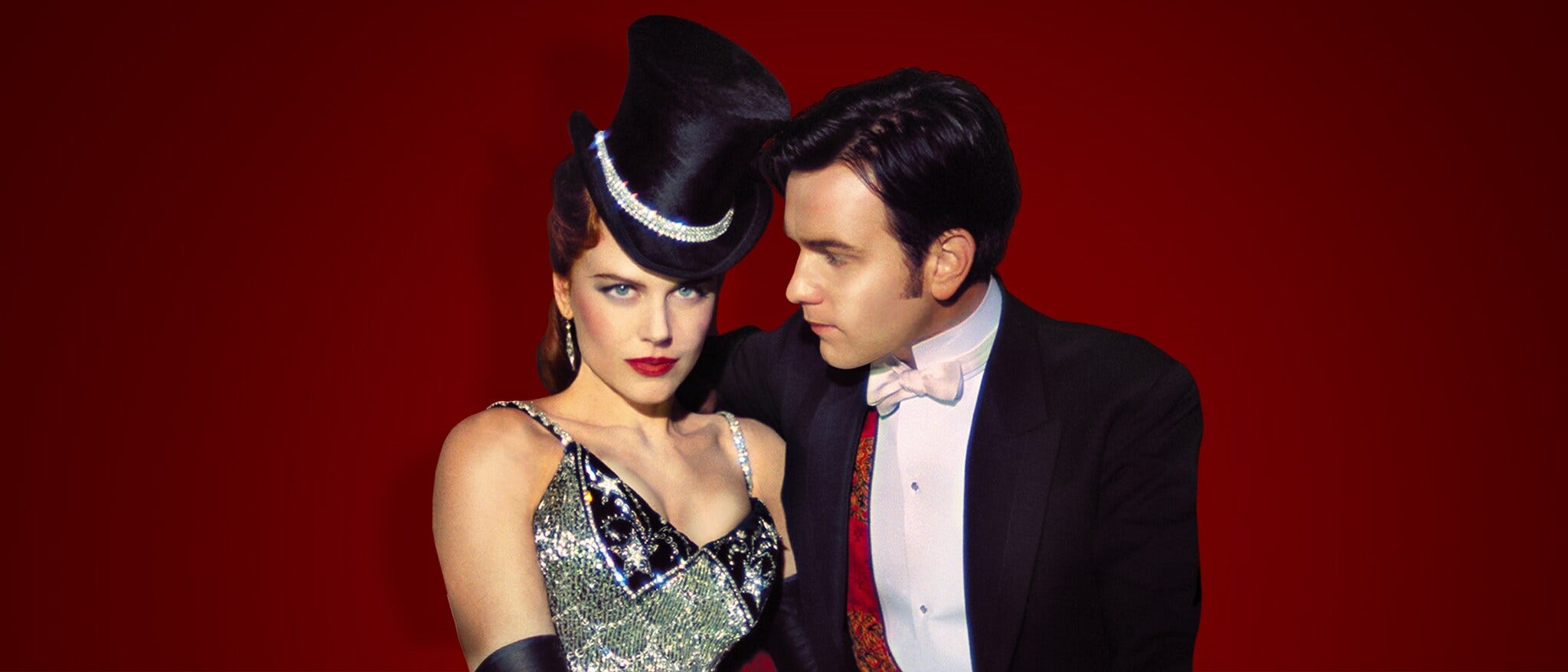
The film’s true power is harnessed through Luhrmann’s bombastic editing, which he uses to mirror the internal state of his characters. When the Moulin Rouge is hectic and busy, the edit is hectic and busy. When a character’s thoughts are racing, the cuts are fast and aggressive. However, Luhrmann knows when to let the pace slow down, allowing the introspective, quiet moments to breathe so that the emotion of the performances can take center stage.
All of that to say, when I decided to watch Moulin Rouge! on a whim late one night in 2021, I was entirely unprepared for its chaotic tone, rapid-fire editing, and over-the-top performances. But I was especially unprepared for its use of music.
(Mis)Understanding Moulin Rouge
You have to understand: my house was full of music growing up, but pop music wasn’t a part of it. Contemporary Christian music was our go-to station on the radio, and in my free time I was listening to musical theater and film scores (I was destined to be a composer). If you needed information on Michael W. Smith, Andrew Lloyd Webber, Beethoven, or John Williams, I was your guy. If you wanted to talk about the Beatles, Queen, or Michael Jackson... better look elsewhere. The closest I came to encountering pop music was a brief Elvis obsession as a kid, thanks almost entirely to his songs being used in Lilo & Stitch.
When Moulin Rouge! opened with an orchestral overture featuring The Sound of Music and Infernal Galop, I should have been keyed in that this film was doing something different with music as a jukebox musical. But instead I thought of it as a fun quirk and nothing more. I didn’t recognize the opening number “Nature Boy” (sung by David Bowie), had never heard the song “Lady Marmalade,” and quickly dismissed Nicole Kidman singing “Diamonds Are a Girl’s Best Friend” since it was being performed diegetically in a nightclub. 20 minutes in, and I still thought this was an original musical.
Things got more embarrassing at the 30 minute mark when I didn’t recognize “Your Song” by Elton John, and at the 40 minute mark I remained blissfully unaware as Nicole Kidman sang the Randy Crawford hit “One Day I’ll Fly Away.” Finally, 45 minutes in (35% of the film’s runtime), I was clued into the fact that this movie might be doing something differently when McGregor and Kidman sang “Elephant Love Medley,” an exquisitely crafted 4 minute song blending portions of ten pop hits: “All You Need Is Love,” “I Was Made for Lovin’ You,” “One More Night,” “Pride (In the Name of Love),” “Don’t Leave Me This Way,” “Silly Love Songs,” “Up Where We Belong,” “Heroes,” I Will Always Love You,” and “Your Song.”
Not to worry, dear reader: I still only recognized two of those ten songs in the medley.
But, that was enough to make me pause the movie, look up Moulin Rouge!, and come to the startling realization that all the songs I’d heard so far (and the rest of the songs I’d hear, which I also didn’t know) were pop music hits, not original songs written specifically for the film.
To be fair—not that my laughable musical ignorance deserves fairness—Moulin Rouge! does a remarkable job at masking the fact it’s a jukebox musical. My past experiences with jukebox musicals such as Mamma Mia! had taught me that pop songs are forced into a narrative, seemingly appearing out of the blue without any care given for the tone of the scenes around the songs. But in Moulin Rouge!, the songs are carefully selected for their lyrical relevance and re-orchestrated by composer Craig Armstrong to better match the film’s style. Armstrong’s work truly transforms the pop songs into masterful pieces of classical art. A melodic snippet appearing in the score or a single line sung in passing often communicates more than ten lines of dialogue ever could.
At least...that’s what it should do. But I completely lacked the foreknowledge the film expected of its audience to have the biggest impact. Moulin Rouge! works perfectly well from a narrative and musical perspective, whether one knows the songs or not. But its musical shorthand—borrowing and recontextualizing pop songs to add new meaning—only works if one knows the shorthand. And that got me thinking about the early church.
Acts and Reframing the Gospel
The book of Acts tells the story of the disciples and the early church fulfilling the great commission given by Jesus: “Be my witnesses in Jerusalem, and in all Judea and Samaria, and to the ends of the earth” (Acts 1:8). Far more than simply recounting events, Acts frequently transcribes the gospel message being preached by the disciples; by my count, no less than ten chapters cover gospel preaching. And, much like Moulin Rouge! and other jukebox musicals, the gospel was being shared in the context of its audience in hopes that they could best derive meaning from it in that form.
In Acts 3, Peter in the temple quotes from Moses’ burning bush experience to show the Jews that their God, the God of Abraham, is still living and active through Jesus. In Acts 7, Stephen appears before the Jewish council and preaches the Gospel by telling the entire history of the Jewish people. In the words of N.T. Wright (who I quote frequently), “Tell the story this way, Stephen is saying, and you will see what I am saying about Jesus and how it relates to everything else that matters. The whole history of the people of Israel is to be understood under this rubric.” Paul does something similar later in Acts, telling listeners in a synagogue, “God made a promise to our ancestors. And we are here to tell you the good news that he has kept this promise to us” (Acts 13:32-33).
Interestingly, Acts does more than frame the gospel in terms of Jewish cultural literacy. In Athens, Paul quotes Greek philosopher Epimenides (“For in him we live and move and have our being”) and Greek poet Aratus (“For we are indeed his offspring”) to begin sharing the gospel with Stoic and Epicurean gentiles. Paul “is not simply constructing a would-be theology out of bits and pieces of the local culture. [He] is demonstrating his familiarity with their own culture, inviting Stoics to come on board with what he’s saying, and offering something quite new and revolutionary” (N.T. Wright, Acts for Everyone).
The Greek philosophers would have differing opinions on this form of preaching. Plato argued that art is “mimesis” (an imitation of an imitation). So when an audience recognizes a familiar shorthand—like Paul quoting poets or Moulin Rouge! using pop songs—they feel a sense of false knowledge. In essence, he felt that this was an insufficient way of conveying truth. Aristotle, on the other hand, recognized that you cannot communicate effectively without cultural shorthand. He coined the term enthymeme, a form of reasoning where one part is left out because the speaker assumes the audience already knows it.
I think Paul would have sided with Aristotle on this debate, and not merely because he resorts to this reasoning in his preaching. Paul explains in the epistles that he uses these familiar refrains as a starting point to “take every thought captive to obey the Messiah” (2 Corinthians 10:5). The audience already has this knowledge, so why wouldn’t he use that knowledge to help them better understand Christ?
Preaching a Jukebox Gospel
Now, as I’ve mentioned, a good story or message overcomes the need for any cultural literacy. I didn’t understand the vast majority of the song references in Moulin Rouge!, yet loved it from the start, a testament to its powerful storytelling. Philip shares the gospel with an Ethiopian official in Acts 8, actually bypassing the official’s lack of Jewish cultural literacy by explaining to him the meaning of the scriptures he couldn’t understand for himself.
But there is something powerful about how a shared understanding can add or deepen meaning to a message. The disciples converted Jews by showing them how Christ was the culmination of their entire history. Paul converted Athenians by demonstrating how the pagan desires of their philosophers and poets were pointing to a longing for Christ.
Most viewers of Moulin Rouge! had a more enlightened experience than my own, similar to Paul quoting the Greeks. The “Elephant Love Medley” impacts audiences much more than an original love song because of our pre-existing knowledge of the pop music. Here, Christian’s musical plea to Satine to give love a chance is the culmination of 20 years of love ballads across multiple genres, artists, and countries.
Or earlier in the film, when the group of Bohemian performers are struggling to write lyrics. “The hills animate with the euphonious symphonies of descant” suggests one, while another offers, “The hills are incarnate with symphonic melodies.” When Christian finally chimes in with, “The hills are alive with the sound of music,” it brings with it a wave of meaning for the audience. Not only is that the best choice for lyrics, it’s the only choice for lyrics, because we know (thanks to The Sound of Music) exactly what those words should be. This cultural shorthand has shown viewers Christian is a musical savant, capable of writing and singing music in its truest form.
![Moulin Rouge! – [FILMGRAB]](https://substackcdn.com/image/fetch/$s_!T4L9!,f_auto,q_auto:good,fl_progressive:steep/https%3A%2F%2Fsubstack-post-media.s3.amazonaws.com%2Fpublic%2Fimages%2Fc47e8ef1-9420-438f-9482-33ca670e44e8_1280x546.jpeg "Moulin Rouge! – [FILMGRAB]")
Much to my wife’s amusement, I don’t enjoy the Broadway adaptation of Moulin Rouge! because it replaces many of the songs with modern alternatives. I may not have known the songs used in the original film, but my constant rewatches have made those specific songs an inextricable part of the experience, rather than just a shorthand to understand the story. I guess you could say I’ve come to appreciate the gospel of Moulin Rouge! (2002) more than the cultural tool used to communicate it.
But, despite my strange journey to loving a film I never fully understood, I do admire the spirit behind modernizing the songs for today’s audience. The producers understood that as time went on, more and more people would be like me, unfamiliar with the songs from the film and lacking the cultural literacy to make the fullest impact.
And so, we update the songs in our jukebox gospel. Not to muddy the message. But to take every thought captive to obey the Messiah.
“The greatest thing you’ll ever learn is just to love and be loved in return.”
— Christian, Moulin Rouge!“We love because he first loved us.”
— 1 John 4:19