
The Carpenter's Son
A strange film where blasphemy meets poignancy...


The following was first published on Film Fisher.
How loosely are you willing to let Biblical figures be interpreted in film?
Do they have to speak verbatim from scriptures, or can their dialogue be modernized? Should the characters resemble their whitewashed appearance in classical paintings, or be more accurate to their cultural background? Can events depicted in such films be extrabiblical if they still resemble what we’d imagine these figures to do?
We all make concessions when watching films about our faith, because scripture is scripture, and movies are not. Dallas Jenkins, creator and director of The Chosen, infamously stated last year “I believe it is important to watch The Chosen as though the Bible didn’t exist.” While this was poorly worded quote that could lead to dangerous interpretations, it speaks to a core truth: Christians must be careful never to let a film or television show be the basis for – or even an undue influence on – their faith.
It’s with this tension in mind that I recently viewed Lotfy Nathan’s new supernatural thriller, The Carpenter’s Son. The film has proven controversial to say the least, so in an effort to better understand what it’s trying to say, my review structure here serves as a (perhaps unusual) blend of theological musings and traditional film analysis. I’ve recently been studying the book of Mark and theologian N.T. Wright’s commentary on that gospel, and as such this has been a fascinating chance to see where the gospels and The Carpenter’s Son are in alignment and where they are at odds with one another.
The Carpenter’s Son is not based on the Bible, but it does feature the characters of Jesus, Joseph, and Mary as it adapts events from the apocryphal and historically controversial Infancy Gospel of Thomas, a text the early church deemed inauthentic and heretical.
In the film, Joseph (Nicolas Cage), Mary (FKA twigs) and their teenage son Jesus (Noah Jupe) have lived for years in Egypt, clinging to their faith and traditions. But a stopover in a small settlement unleashes growing chaos when a mysterious stranger (Isla Johnston) tries to entice young Jesus to abandon his devout father’s rules. With every pull of temptation, the boy is lured into a forbidden world, as a terrified Joseph realizes that a demonic power is at work. Violent, unnatural events inexplicably follow Jesus, and he begins to experience nightmarish visions of the future. Finally, he learns the fearsome truth about his new playmate, as well as the child’s real name: Satan.
Jesus, Temptation, and the Problem of Source
The most immediate source of discomfort for a Christian viewer lies in the film’s depiction of Jesus himself. This is, admittedly, a fault carried over from the heretical Infancy Gospel of Thomas, but regardless of the source, Jesus’ characterization is problematic at best, and blasphemous at worst.
The film portrays teenage Jesus as rebellious, flawed, and profoundly unsure of his own identity and divine nature as he questions who his real father was. Noah Jupe, for his part, delivers an admirable performance, bringing a contemplative maturity yet doubting adolescence to the role.
The film finds firmer thematic footing in its exploration of temptation. Satan’s temptations here are less about earthly power and more about the desire to relieve suffering, an interpretation that at least feels consistent with the spiritual battle Christ would eventually face in the wilderness and in the garden.

The temptations feel effective because this film’s world, more than many shown in Biblical adaptations, is truly a world in need of saving. Death, pain, suffering, and fear are ever-present. The costumes, makeup, and production design all contribute to that feeling, with a grimy, dirty and naturalistic look establishing a fallen Earth. The film’s naturalistic lighting also serves that purpose during daytime scenes, though it creates an overly dark and flat look at night that is far less effective. Satan’s temptations feel appropriately alluring in the film because the world here looks and feels hopeless, a true testament to the entire crew’s work.
The difference though in Jesus’ depiction and battle with temptation in this film is one of identity. Controversial films like The Last Temptation of Christ – which I’ve adamantly defended – still depict Jesus as aware of and confident in His identity as God’s son, but facing temptations about the burden of responsibility on his shoulders (a characterization aligned with Luke 22:42).
But in The Carpenter’s Son, Jesus is unsure of who He is and is acting out as a result, a take I have trouble reconciling with scripture (though, again, in all fairness, this film is based on a non-scripture text). It’s simply a core issue of the character’s depiction, to the point where I wouldn’t fault Christian viewers for being unwilling to watch.
Joseph, Doubt, and Divine Revelation
As much as I take issue with the film’s depiction of Jesus, the true emotional core of The Carpenter’s Son lies not with Jesus, but with Joseph, carefully written and magnificently portrayed by Nicolas Cage. Joseph’s arc in the film has lingered with me long after watching, a representation of the Biblical stubbornness of the Jewish people and the new hope that God sent through Christ.
At the start of the film, Joseph sees God’s light shine on him during the birth of Jesus, but years later he feels as if God is absent during their time in Egypt. “My faith has become a broken crutch,” he cries to the heavens. “I beg You, how much longer must I wait to see Your light again?” Try as he might, he struggles to hear God’s voice and battles doubts about whether Jesus is truly God’s son.
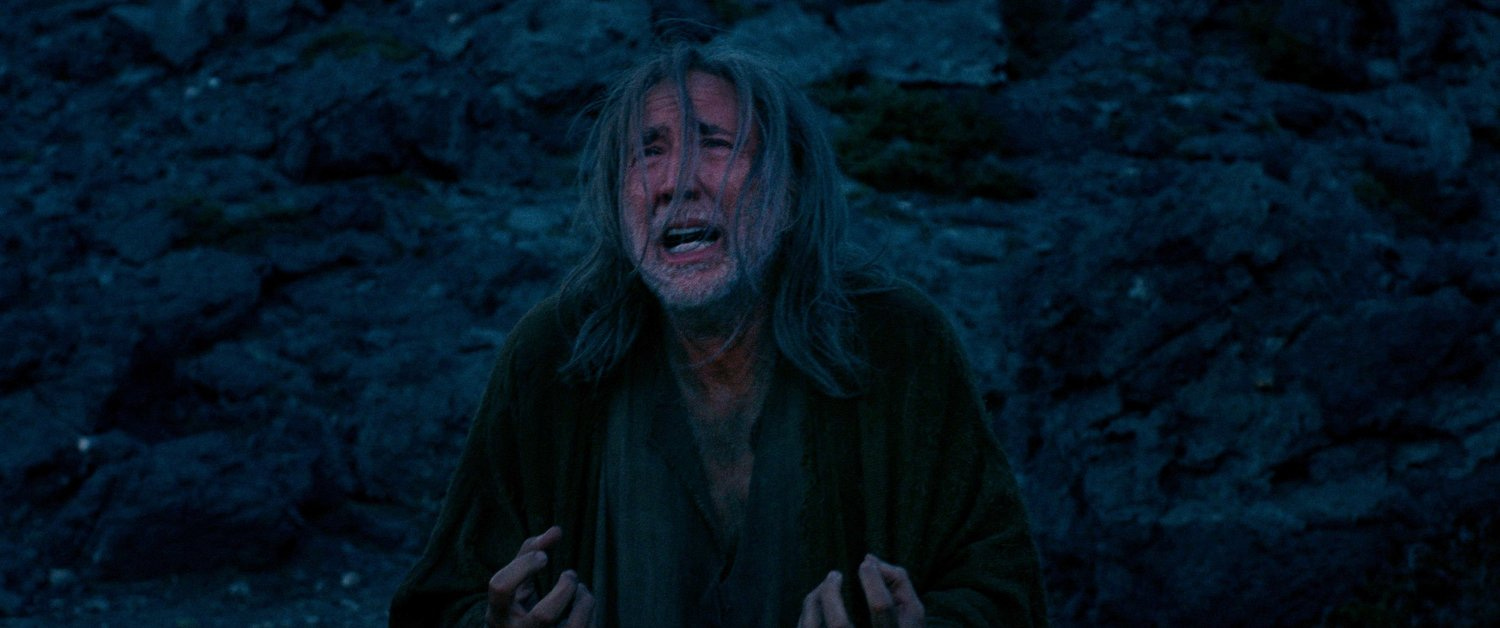
Though still not biblically rooted, it’s much easier to align this portrayal of Joseph with his biblical counterpart, whether it’s Joseph’s pre-birth doubts in Matthew 1:19 or Mark 3:21’s mention of how Jesus’s family “thought he was crazy and went to get him under control.”
But even on a metatextual level, Joseph functions in the film as a powerful metaphor for the Pharisees and the Jewish people of the era, clinging to ritual in the face of a God they no longer perceive. Joseph is so stuck in the Jewish traditions and laws that he fails to see the new thing God is doing through Jesus.
“What Jesus is doing can’t be fitted in to the existing ways of thinking and living that his fellow first-century Galileans already had. Jesus was challenging, by his whole kingdom-movement, the very basis on which the Pharisees had built up their edifice.”
- Mark for Everyone, Tom Wright
His frustration with Jesus’s lack of adherence to the Law leads to the film’s best scene, a fight with Mary about Jesus’s true identity. When Mary asks if he has doubts about her immaculate conception, Joseph confesses, “Of course I have doubts, my faith is shattered.”
Joseph is still bound by legalistic fear and fundamentalism. His prayers are delivered in a monotonous chant, practiced rather than heartfelt. When he punishes Jesus by making him list the things one cannot do on the Sabbath, there are clear parallels to the many conflicts between the Pharisees and Jesus over the Law, specifically the Sabbath (Mark 2:23-28, Mark 7:1-13).
THE MOTHER
He is innocent.

THE CARPENTER
How do you know He is innocent?

THE MOTHER
Because of our faith. Because we know who He is.

THE CARPENTER
But is it good? Is it righteous?
The Sabbath had become a weapon for many Jews, a symbol of an exclusive, fiercely nationalistic commitment. Joseph’s fixation on these specific rules highlights how, for him, “the rule mattered more than the reality” (Mark for Everyone, Tom Wright). The true meaning of the commandment, celebrating God’s redemption, had been lost beneath a layer of human custom.
Even through his fundamentalism, the film does offer glimpses of Joseph’s virtue, such as when he washes Mary’s feet. This act of servanthood suggests that despite his flaws, his faith still leads him to exhibit the true, Godlike love that Jesus would later perfect.
In the third act, The Carpenter’s Son pushes Joseph’s internal struggle to both a physical and theological climax. When a snake bites Joseph’s leg (with echoes of Gen 3:14-15), Jesus arrives and demands that Joseph tell him who his Father is. Hesitant, due in large part to his belief that to speak God’s name is a sin, Joseph finally admits that Yahweh is Jesus’s Father. Only then does Jesus heal the snakebite, as if to tie Joseph’s physical healing to his spiritual breakthrough and echo Christ’s words in the gospels, “Your faith has healed you.” The snake, in this context, becomes a metaphor for how sin was closing Joseph off to God’s new work in Jesus.
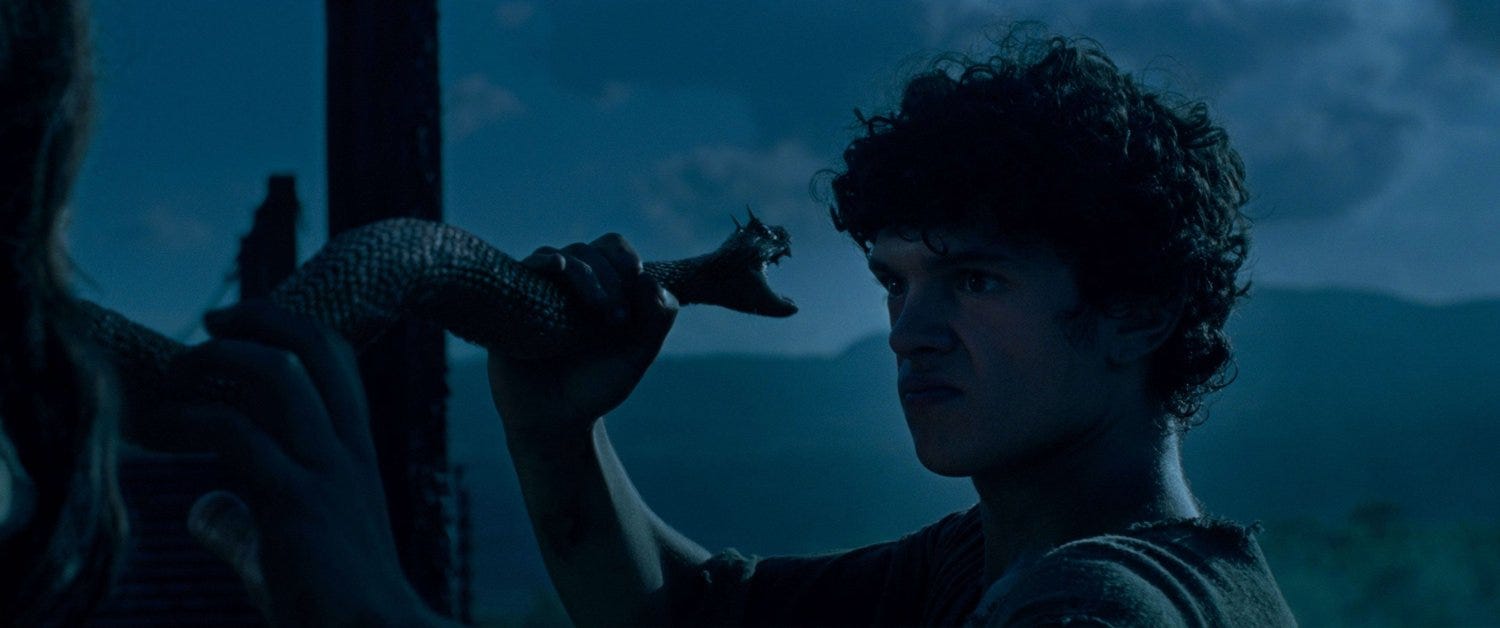
Joseph’s journey from rigid religious adherence to the eventual confession of Christ’s identity underscores the film’s best (if perhaps unintended) theological lesson: the law and the scriptures all point to Christ.
“The scriptures spoke of purity, and set up codes as signposts to it; Jesus was offering the reality. When you arrive at the destination you don’t need the signposts any more, not because they were worthless but precisely because they were correct. The starting-point is to realize that the Jewish scriptures aren’t to be seen as a timeless code of behaviour, but as the story which leads to Jesus.”
- Mark for Everyone, Tom Wright
The Carpenter’s Son forces Joseph to let go of the signposts (his strict, nationalistic interpretation of the Law) because the destination (the living Christ) has arrived. It’s an incredible and emotional journey, one well-suited to Nicolas Cage’s frequently overdramatic nature. Cage swings big here, delivering a performance that is at times jarringly out of sync with the others, but which perfectly matches the character’s spiritual dissonance with the divine events unfolding around him.
A Film For No One?
For all its strengths and flaws, The Carpenter’s Son ultimately suffers from a lack of clear audience focus. A film intended for Christian audiences – even one meant to challenge them – should have been more careful in its handling of the nature of Christ. But a film intended for secular audiences might have taken greater narrative risks instead of relying so heavily on subtle biblical imagery and themes that only religious viewers would truly recognize and understand.
This makes The Carpenter’s Son a particularly difficult work to unpack. It’s not scripturally accurate, but it never claims to be. And while many Christians (including myself) will take issue with its depiction of Jesus, I hope viewers will at least take the opportunity to place themselves in Joseph’s shoes and arc.
Particularly in this time of advent, how will we react when confronted with the new work of our living, mysterious God?