
Films to Watch for Easter
Five underrated films to watch for Holy Week...


Happy Holy Week!
It’s a common tradition for many to spend the month of December watching Christmas movies to prepare for the holidays. But my favorite movie-watching season is in the weeks leading up to Easter. My writing here often focuses on the intersection of faith and film, so it only made sense I recommend some biblical films to watch for Easter.
Readers familiar with biblical films are likely aware of the classics. Mel Gibson’s The Passion of the Christ (2004), while intense, is a signature film to watch at Easter, perhaps the best depiction to date of Jesus’ crucifixion. King of Kings (1961) is a more traditional biblical epic, telling the full story of Jesus’ life, death, and resurrection. Lesser known—though popular among cinephiles—is The Gospel According to St. Matthew (1964), directed by Pier Paolo Pasolini. It’s a uniquely affecting watch, employing a cast of mostly amateur actors, filmed entirely in Southern Italy, and with all of its dialogue taken directly from the Gospel of Matthew.
Passover films are also popular this time of year, and two in particular are staples of mine each spring. The Ten Commandments (1956) stars Charlton Heston as Moses, clocking in at a whopping 220 minutes and filled with romance, excitement, and spectacle. The parting of the Red Sea is a visual effects marvel in a pre-CGI era. A personal favorite of mine is The Prince of Egypt (1998), DreamWorks Animation’s retelling of the Exodus story. I’ve written about the film in the past, analyzing how the animation and music beautifully capture the grandeur, emotion, and spiritual gravity of the events portrayed.
But for viewers looking for more obscure, unique, or even difficult movies to meditate on this time of year, I’ve compiled a list of five underrated films to watch for Easter. These selections aren’t always as clean-cut as many traditional Bible retellings. But, much like the mission of this outlet, these films are valuable because of their “cloudiness.” We don’t know everything, but part of the journey is seeking to find the meaning amidst the clouds.
The Book of Clarence (2023)
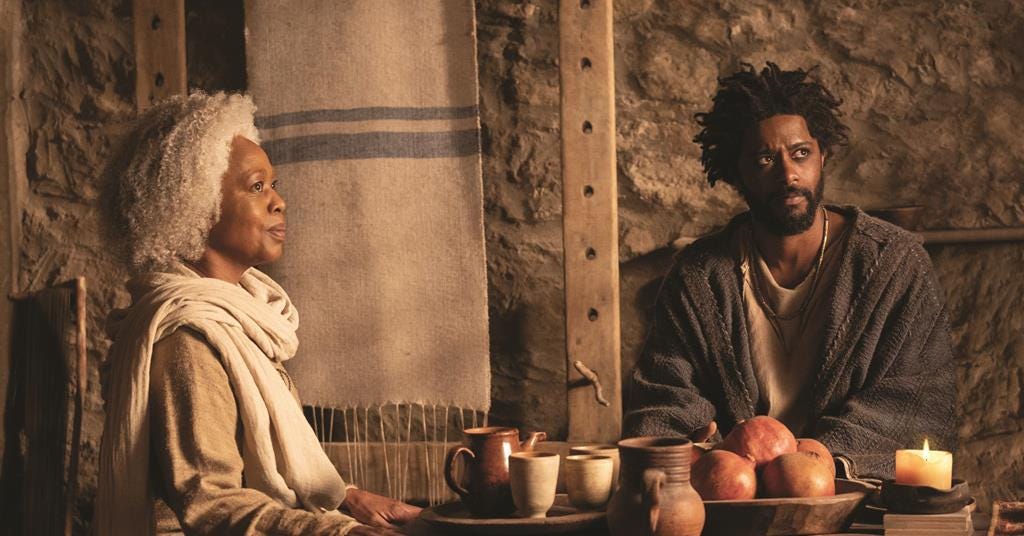
Streetwise but down-on-his-luck, Clarence is struggling to find a better life for his family, while fighting to free himself of debt. Captivated by the power and glory of the rising Messiah and His apostles, he risks everything to carve his own path to a divine life, and ultimately discovers that the redemptive power of belief may be his only way out.
While an admittedly unconventional take on the gospel story, The Book of Clarence offers a profound meditation on knowledge and faith. Writer and director Jeymes Samuel emphasizes the innate human longing for identity and understanding, centering the film on Clarence, twin of “doubting Thomas” the apostle. And yes, for those who are wondering, the Bible does say that Thomas was a twin.
Clarence mirrors his biblical brother’s skeptical traits but goes a step further by rejecting faith entirely, preferring instead to seek knowledge and “enlightenment.” But as his attention-seeking schemes get him in more and more trouble, he’s confronted with the truth he’s been running from: perhaps real enlightenment can only be found in Christ.
The film’s style is strange to say the least, inspired by everything from biblical epics to Spike Lee to Quentin Tarantino. But beneath that chaotic style is a hilarious story and touching spiritual message, making it one of my favorite faith films of all time.
Read my extended thoughts here:

You can watch The Book of Clarence on Hulu.
The Miracle Maker (1999) | Films to Watch for Easter
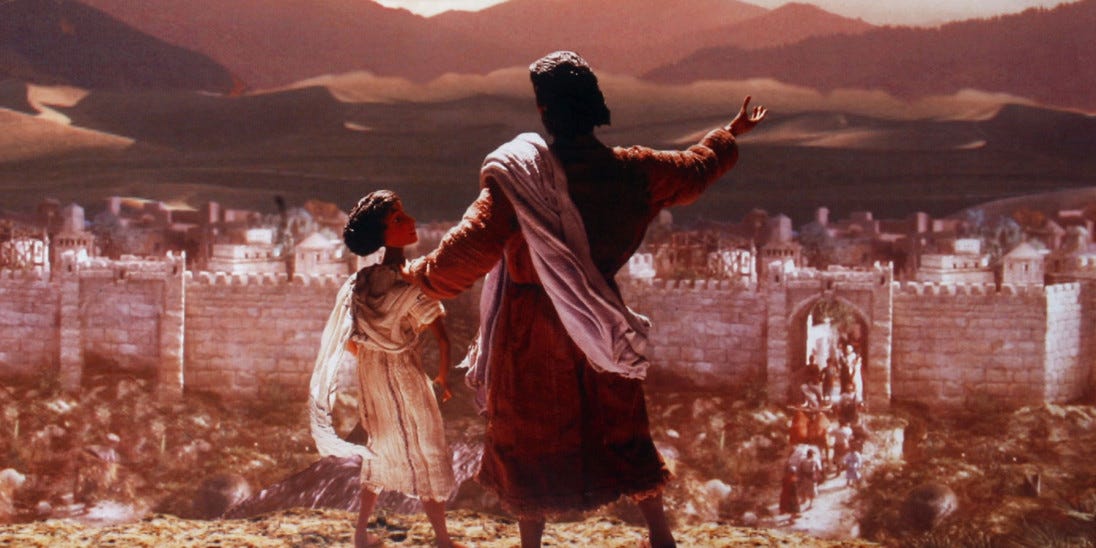
‘The Miracle Maker’ tells the story of the life of Jesus, voiced by Ralph Fiennes, from the perspective of secondary characters such as his disciples, the high priests and in particular Tamar, the daughter of Jairus, previously unnamed in the Bible.
This under-seen gem was a staple for me as a kid and I still return to it each year. The stop motion animation offers the ancient biblical setting a tangible feeling, beautifully contrasted by the flowing, hand-drawn animation used for parables. And that’s to say nothing of the all-star voice cast: Ralph Fiennes, Alfred Molina, Richard E. Grant, Ian Holm, and Emily Mortimer to name a few.
But beyond its merit as simply a great movie, The Miracle Maker showcases perhaps the best cinematic example of Jesus’s dual identity as fully God and fully man. We see this Jesus laugh, cry, suffer, and love, all while retaining a mystic and miraculous presence. It’s incredibly well written and tenderly performed, and I was thrilled it landed on the Arts & Faith Top 100 list last year (#32).
You can watch The Miracle Maker free on YouTube and Tubi, or stream on Prime Video.
The Last Temptation of Christ (1988)
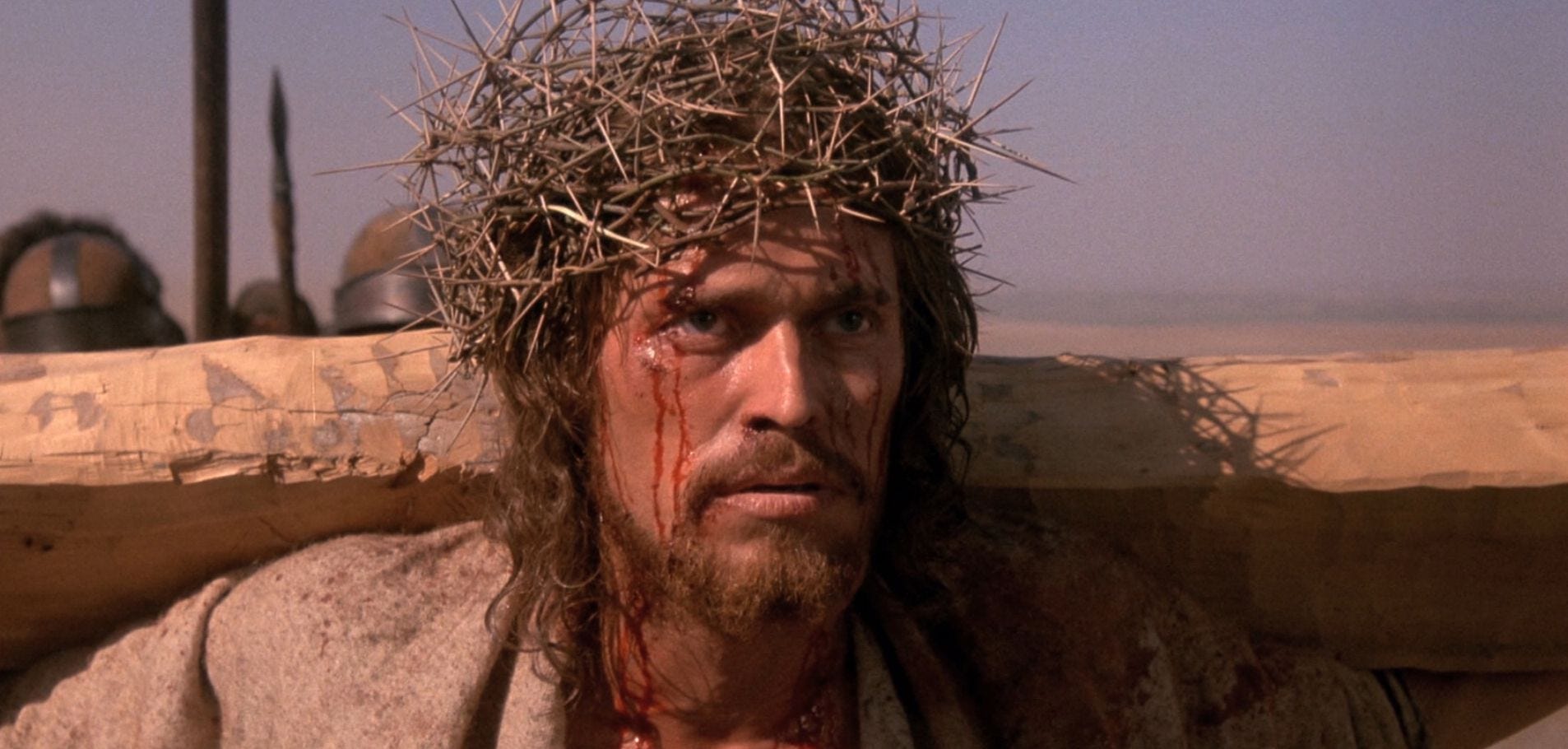
Jesus is drawn into revolutionary action against the Roman occupiers by Judas – despite his protestations that love, not violence, is the path to salvation. The burden of being the savior of mankind torments Jesus throughout his life, leading him to doubt.
No one should go into The Last Temptation of Christ (or frankly any film) expecting scriptural authority. In fact, I’ve always appreciated that this film opens with a blunt disclaimer: “This film is not based on the Gospels, but upon the fictional exploration of the eternal spiritual conflict.”
While I’d argue that Silence is Martin Scorsese’s best film on faith, The Last Temptation of Christ is the film I consistently revisit each Easter. Just as the opening text states, Last Temptation is all about the spiritual conflict of being tempted, showing both the internal and external battle between the human and the divine, part of the burden of Christ’s messianic role.
How is it even possible for someone to equally inhabit both man and God? It’s hard for the human mind to comprehend, and that struggle is the focus of Scorsese’s challenging work. The film isn’t biblically accurate (though it sticks truer to scripture than some give it credit for), but viewers get perhaps the best chance to put themselves in Christ’s shoes and see the difficulties of living a sinless, blameless life in human form.
Read my extended thoughts here:

The Last Temptation of Christ is not currently streaming, but can be digitally rented, purchased, or bought physically from the Criterion Collection.
Barabbas (1961) | Films to Watch for Easter
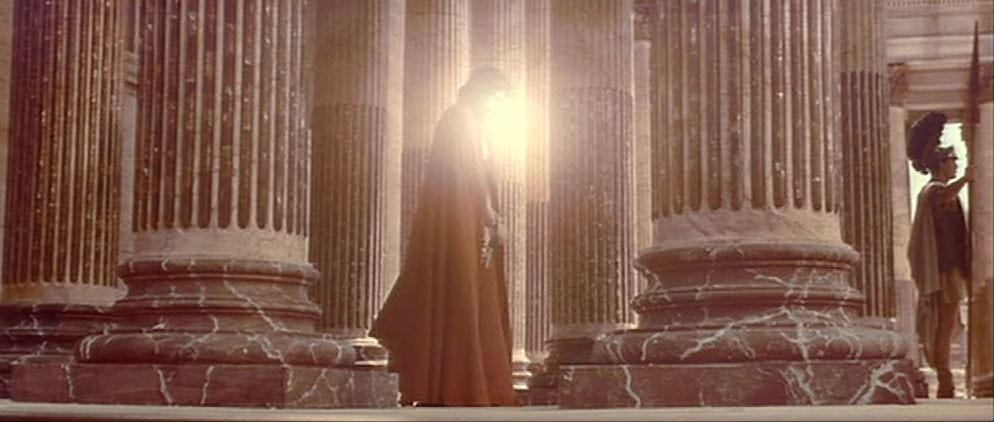
Epic account of the thief Barabbas, who was pardoned for his crimes and spared crucifixion when Pilate offered the Israelites a choice to pardon Barabbas or Jesus. Struggling with his spirituality, Barabbas goes through many ordeals leading him to the gladiatorial arena, where he tries to win his freedom and confront his inner demons, ultimately becoming a follower of the man who was crucified in his place.
Barabbas was a first-time watch for me this year, and it’s a fascinating film. It contains the extravagant scale and lavish production design often associated with biblical epics, but the focus is far more interior. Every huge set, every swell of the music, and each of the hundreds of extras is used to further Barabbas’s arc, from Christ’s crucifixion scene to the gladiator fights to the burning of Rome.
Speaking of the crucifixion, here’s a fun fact: to portray the Earth going dark during Jesus’ death, the cast and crew filmed the crucifixion scene during a real solar eclipse. The film lingers on a single eclipse shot for a full 45 seconds, forcing you to take in the supernatural wonder as the view of the cross slowly darkens.
And that’s to say nothing of the film’s spiritual depth! Despite his best attempts to run from faith, Barabbas can’t seem to escape the pull he feels towards Christ, a mixture of shame, guilt, and genuine intrigue at the figure who took his place and died. One of my favorite interactions is between Barabbas and the apostle Peter.
Barabbas: I was the opposite of everything he taught, wasn’t I? Why did He let Himself be killed instead of me?
Peter: Because being farthest from Him, you were the nearest.
Barabbas: I’m no nearer than I was before.
Peter: Nor any farther away. The truth of the matter is, He’s never moved from your side. I can tell you this: there has been a wrestling in your spirit back and forth in your life which, in itself, is knowledge of God. By the conflict you have known Him.
You can watch Barabbas free on Tubi.
La Vie du Christ (1906)
The stations of Christ’s life are segmented into a series of performative tableaux.
For casual moviegoers, La Vie du Christ (The Birth, the Life and the Death of Christ) may not be as “fun” or “easy” a watch compared to other films on this list. But at 120 years old, this film is significant for a multitude of reasons. While early cinema history has a lot of gaps, La Vie du Christ is one of the earliest movies about Christ ever made, and almost certainly the first major biblical film directed by a woman.
At only 33 minutes, Alice Guy-Blaché’s film is a quick watch, but it hits on all the major moments in Jesus’ life, with the scenes shot almost as living portraits (you can see why the medium of film was described early on as “motion picture”). The camera barely moves in any given scene, turning each viewer into a biblical witness as each event unfolds, from Jesus’ birth, ministry, trial, death, and resurrection. I’m honestly still not quite sure how the resurrection scene was shot, a breathtaking sequence in which Jesus levitates above the grave before disappearing.
I watched this film in preparation for voting on the upcoming Arts & Faith Women-Directed Films list. You can check out the other nominees below:

You can watch La Vie du Christ free on YouTube.
What are your favorite films to watch for Easter? Comment below and let me know what I may have left out!