
Lois Weber's Hypocrites (1915) | Arts & Faith Nominee
#16 on the Arts & Faith Top 25 Films Directed by Women

This article was written for the Arts & Faith Top 25 Films Directed by Women.
The story and significance of Hypocrites is best told in the context of its maker, writer and director Lois Weber.
Weber first began working in the film industry in 1907 (under fellow Arts and Faith nominee Alice Guy-Blaché no less). In the ensuing years, she would establish herself as not only the most important woman director of the silent era, but one of the foremost creative voices of the time, alongside the likes of Cecil B. DeMille and D.W. Griffith.
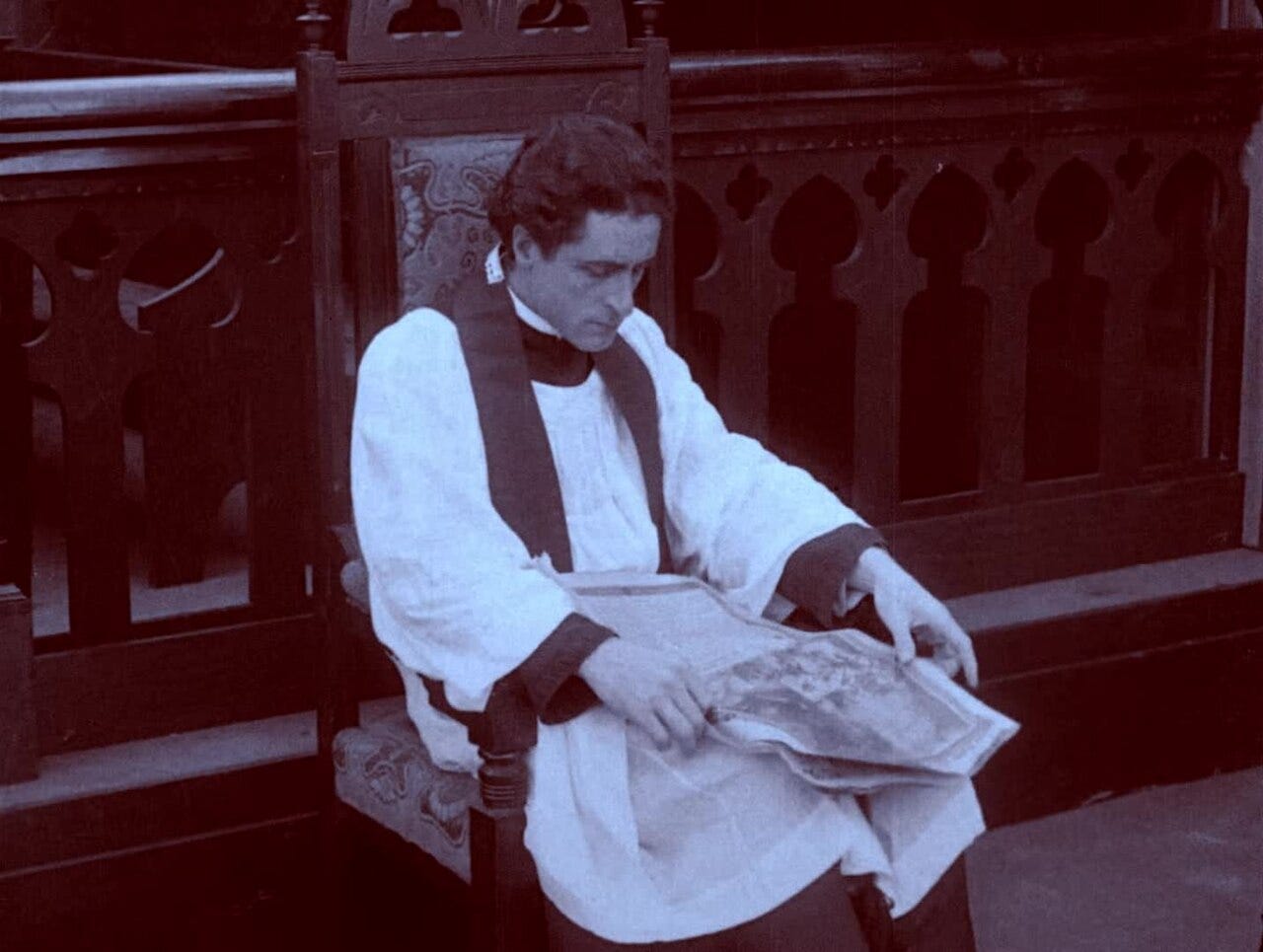
Her 1915 classic, Hypocrites, was provocative, controversial, shocking, and innovative, but perhaps most importantly, marked the first feature-length film ever directed by an American woman. In the film, a medieval monk’s unveiled sculpture of a “naked Truth” sparks a riot, followed by a parallel narrative where he is reimagined as a 1910 Protestant pastor preaching to his congregation before being guided in a dream through a series of vignettes by a ghostly, nude personification of Truth.
Compositionally, Hypocrites represents many of Weber’s signatures as a director. Her 1913 short film Suspense is often credited as the first film to utilize a split-screen technique, and that same year, her short The Rosary framed film scenes through circular matte shots inside a beaded rosary necklace. These pioneering techniques are evident throughout Hypocrites, with some shots designed as if the audience is looking through a window or picture frame. Beyond merely innovative, this framing adds to the feeling of the pastor (and the audience) being an onlooker in the visions revealed by the “naked Truth.”
The nudity of Truth is an important part of Hypocrites’ legacy. The first non-pornographic depiction of nudity in film, the concept for the unclothed character (and the film as a whole) was not sexual in nature, but was based on an Adolphe Faugeron painting. Despite its artistic merit, Hypocrites faced a two-month delay by the National Board of Review of Motion Pictures, was banned in Ohio, and caused riots in New York. The film was eventually released to great financial and critical success, thanks to “Weber’s sincerity and reputation, [which] allowed her to use something that in the hands of a male director would have been considered scandalous and immoral” (Kino Lorber).
That sincerity is a key part of Weber’s legacy as an artist and unlocks the film’s meaning. Weber saw movies as “a vehicle for evangelism,” sharing in an interview, “In moving pictures I have found my life’s work. I find at once an outlet for my emotions and my ideals. I can preach to my heart’s content.” Sadly, that sincerity lost its appeal by the 1920s, as Jazz Age audiences found her moral films old-fashioned and preferred a more carefree kind of entertainment.


The hypocrisy on display in Hypocrites is multi-faceted and even metatextual. Early on, fellow monks treat their monastery as an irreverent social gathering rather than a place of prayer and worship. When the righteous monk unveils his statue of the naked Truth, impressive panning and tracking shots reveal everyone in attendance is aghast, from scholars to nuns to royalty. They all may claim to pursue truth in some shape or form, but when actually confronted with Truth, they riot and rebel.
The film jumps to a modern congregation hearing a sermon on hypocrisy, and their reactions are just as poor. Some are merely bored by the lecture, while others gossip, taking offense and calling for the pastor’s resignation. During a dream sequence, Truth reveals the endless hypocrisies of the modern world. A politician promising honesty but accepting bribes. An unfaithful husband. An immodest group of youths.
Arguably though, the hypocrisy implicates the pastor himself. In his dream, he summits a mountain in pursuit of Truth but refuses to help others, whether it’s a family trying to carry their child to Truth, or a woman hanging on the edge of a cliff and begging for his hand. Is he modeling Luke 14:33 in a relentless pursuit of God’s truth? Or is he in danger of a Matthew 25:45 condemnation? “Whenever you failed to help any of my people, you failed to do it for me.”
The question of hypocrisy even extends to the audience. Are we guilty of modeling the hypocritical behaviors on display in the congregants? Have we been the self-righteous pastor, more interested in lecturing lost souls than saving them? Or are we perhaps even offended by the filmmaking itself, so turned off by the display of nudity that we nullify its message about Truth?
It seems in any form and at any age in history, the naked Truth is offensive to many, and as such, the film tests its audience’s own assumptions on truth and hypocrisy. In the words of Weber, “Hypocrites is not a slap at any church or creed - it is a slap at hypocrites, and its effectiveness is shown by the outcry amongst those it hits hardest, to have the film stopped.”
In one final and ironic twist of hypocrisy, producers and audiences alike that had once championed Weber’s filmic mission for truth gradually rejected her didactic style until she died bankrupt and relatively unknown in 1939. When asked a few years before her death to offer advice to women seeking to enter the industry, she curtly replied: “Don’t try it. You’ll never get away with it.” Thankfully, for a time, Weber did get away with it, and her evangelical efforts in film endure via Hypocrites more than 100 years later.
In addition to participating on this year’s Arts & Faith jury (you can read more of my thoughts here) was honored to edit and write music for this tribute video about the 25 winners.